



Welcome to How Solos Scale. Each week, we share a new framework, concept, or example of how solopreneurs & micro agencies are scaling from $30,000 to $100,000+ per month.
Hey there,
Most solopreneurs don’t decide to build an agency.
You just run out of capacity, so you make the most logical next move.
A good referral comes in when your client roster is full, so you bring on a contractor to help with delivery. The referrals keep coming, the contractor becomes a regular, and at some point, the business has overhead to cover every month.
That shifts the sales math. You start saying yes to clients you wouldn’t have considered a year ago. A person is relying on you for work, and you feel obligated to send it their way. The work gets spread thinner, you’re less involved, and, without consciously realizing it, you hand off the client relationships to someone else.
Each of these micro decisions is logical.
But if you’re like most solopreneurs who come to us, you never sat down and decided to build an agency. It just happened. One logical move at a time.
You think once you hit capacity, the answer is more headcount. You assume that growing your services business means growing your team.
But growth and scale aren’t the same thing, and that distinction matters.
Growth means revenue goes up because costs and inputs do too. You add clients, so you add people. You add people, so you add overhead. You add overhead, so you need more clients. The business gets bigger, but the margin doesn’t necessarily improve, and neither does the founder’s life.
Scale means revenue goes up while costs stay mostly fixed. You add leverage instead of headcount. The business produces more from the same inputs. That’s what the micro-agency is built for.
Choosing not to scale is a deliberate design decision most solopreneurs never think to make.
Oftentimes, it’s because nobody told them it was an option.
At Duo, we hit our own capacity ceiling not long ago. But when our accountant asked how much we planned to spend on contractors and production in the coming year, we looked at each other and said, “zero.”
We ran the math. Hiring more people to crank up revenue didn’t change what ended up in our pockets. It just added overhead, complexity, and people to manage. At this stage of our business and our lives, the pocket number is what matters. A leaner business produces more of it.
That “more in my pocket” number is the point of staying small.
We call this the micro-agency model: a small, standardized, and high-margin business.
There’s no single right version of it. One of our clients runs a one-person shop with an EA and does $300K a year. Another client has a small team (3 full-time contractors) doing $200K months. Both are micro-agencies.
This mini-book lays out the micro-agency model layer by layer: what it is, how the math works, and what it takes to build one.
You’ll find out what drives the traditional agency model and why so many solopreneurs end up building a business they didn’t intend. You’ll see the five components that make a micro-agency work, and the specific decisions you’ll need to make at each stage.
Every framework in our mini-book series (you can read them all here) points to this destination. The micro-agency is what it looks like when it all comes together.
If you’re doing $30–50K months and the only next move you can picture is more headcount and complexity, know there’s another path.
Let’s get into it.
What Is a Micro-Agency?
A micro-agency is a small, owner-operated services firm, typically one to four people, built around a standardized service, a finite client roster, and a founder who stays close to the work that matters.
It’s not a solo practice trying to grow into something bigger or a traditional agency that’s been trimmed down.
It’s a specific model, built intentionally from the start.
The defining features are simple.
The client roster is small, usually somewhere between five and fifteen retainer clients, though some go higher.
The service is standardized, meaning every client follows the same engagement model rather than a custom-scoped solution each time.
And the economics are structured around margin, not volume.
The goal is to do the right amount of work, at the right price, with the right clients.
What makes this model distinct is what it’s not optimizing for. Most businesses are built to grow clients, revenue, and headcount.
The micro-agency optimizes for a different outcome: more take-home profit, with less drag.
Why Solopreneurs Fall Into the Traditional Agency Trap
When solopreneurs hit capacity, the default move is to hire someone.
That logic makes sense, and we aren’t against it. We help our clients hire their first or second contractors all the time. The problem isn’t the decision to hire, it’s the how of it all.
Most people hire the way they’ve seen hiring done, without thinking through what kind of business they’re building. They bring on a new employee. Then another. They start structuring things the way an agency would, because that’s the model they know.
By the time they look up, they’ve got more overhead than they ever planned for. Their margins suck, their energy is drained, and they’ve accidentally built the one thing they swore they never would.
Whoops.

When their friends and peers ask, “What are you building?” they say, “I don’t know, I’m just doing stuff.”
Most of us never sit down and decide to build a traditional agency. (We’re not delusional!) We just keep making the next logical move until the business looks like one.
But the other path, staying solo and grinding, also has its own ceiling and complications.
You can get to $20K, maybe $30K/month on a solid work ethic and strong output. But at some point, you’re the bottleneck on every piece of work. There’s no leverage. Growth requires more of you, and there’s only so much of you to give. That leads to burnout and a business that takes over your life.
The micro-agency is the third option most people never see.
The Math That Makes a Micro-Agency Work
Everyone talks about revenue, but no one talks about what ends up in your pocket.
$200K per month at 50-60% margins means you’re spending somewhere around $70K a month on a team and operating costs. Add in taxes, and you’re probably taking home around $70K a month.
That’s an amazing outcome, but it requires managing multiple people, running a complex operation, and dealing with (waves hands) all of it all every single day.
For comparison, our two-person business generates a bit less revenue per month, and we split that revenue 50/50. So right away, 50% of our margins are gone.
Because of that, we make what our accountant described as “very low spend” for a business our size, because we’ve designed it that way. When we looked at how hiring more people would affect our take-home pay, the math didn’t support it. We’d have a bigger top line, more complexity, and roughly the same number in our pockets. That’s not a trade we want to make.
Someone we respect who knows our numbers, put it plainly: We make more than two founders he knows who are doing $1.7M combined, because their expenses eat the difference.
People brag about top-line revenue, but the number that matters is what you take home.
Those two amounts are often not correlated.
A micro-agency is built around what ends up in your pocket. You evaluate your client roster size, pricing, team structure, and decision about whether to hire through that lens.
When you build a micro-agency, you opt into a small, focused client roster. This means the relationships are deep, but your pipeline has to be reliable.
You opt to stay close to the work, which maintains high quality. But you don’t get to fully step away from delivery.
You opt into a business that’s designed to produce high take-home income without requiring you to manage a large team. But this requires you to manage yourself, your positioning, and your sales process with discipline.
What you opt out of is the traditional growth story.
You’re not building toward an exit. You’re not trying to hit a revenue number that looks impressive in a LinkedIn post. You’re not building a team to run the business while you step back. If those things are what you want, the micro-agency probably isn’t the right model, and that’s a legitimate choice.
The clients we work with who’ve built a successful micro-agency know what they want the business to do for their lives.
They have a revenue goal but also an honest picture of what “enough” looks like. That’s harder to figure out than it sounds. Most people skip “enough” entirely and keep building indefinitely, assuming more is always better.
A micro-agency asks you to think honestly about “enough.”
Now, let’s get into the building blocks of a micro-agency that’s sized right for what you want.
The 5 Components of a Micro-Agency
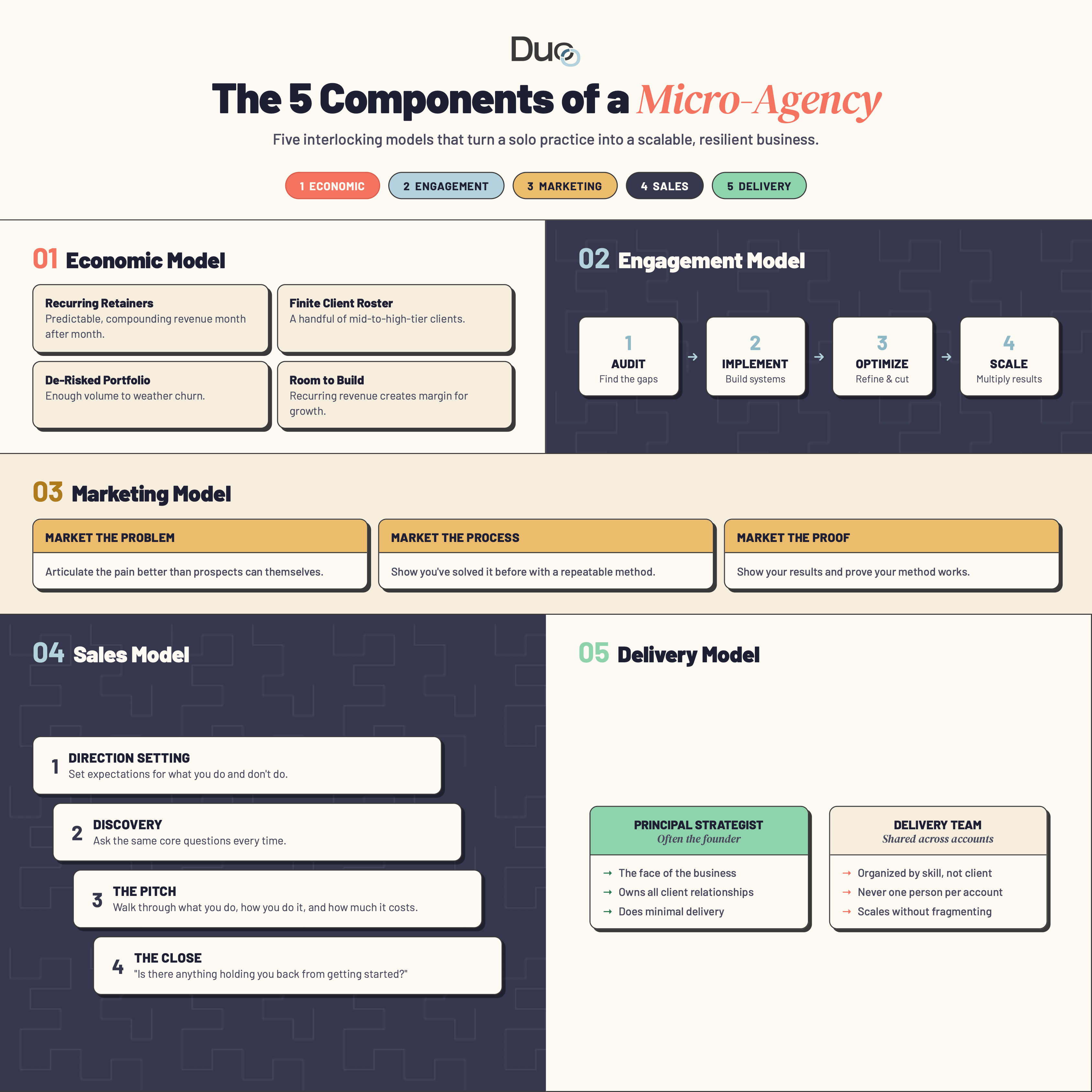
The micro-agency is a configuration of five specific components that work together to create a business that’s small by design, high-margin by intention, and built to last without burning you out.
Economic model
Engagement model
Marketing model
Sales model
Delivery model
Each one builds on the last. Change out any one of them, and you’re no longer building a micro-agency. Let’s break down each component to see why the model works this way.
Component 1: The Economic Model
The foundation of the micro-agency is how you structure the money.
The baseline is retainer-based, recurring revenue, with a finite client roster. But the more important question is how you calibrate the numbers because the economics of this model are more nuanced than most people expect.
There are two modes on either end of the spectrum:
On one end is the highly productized model: high volume, low recurring revenue, and constant pipeline pressure. The math only works if demand stays strong every single month, which makes it inherently risky.
On the other end, the fully custom model: large engagement fees, but your client impact values are so high that one departure wrecks the portfolio. When a single client owns 40-60% of your revenue, and they leave, you lose nearly half your business overnight.
The micro-agency sits between those two extremes.
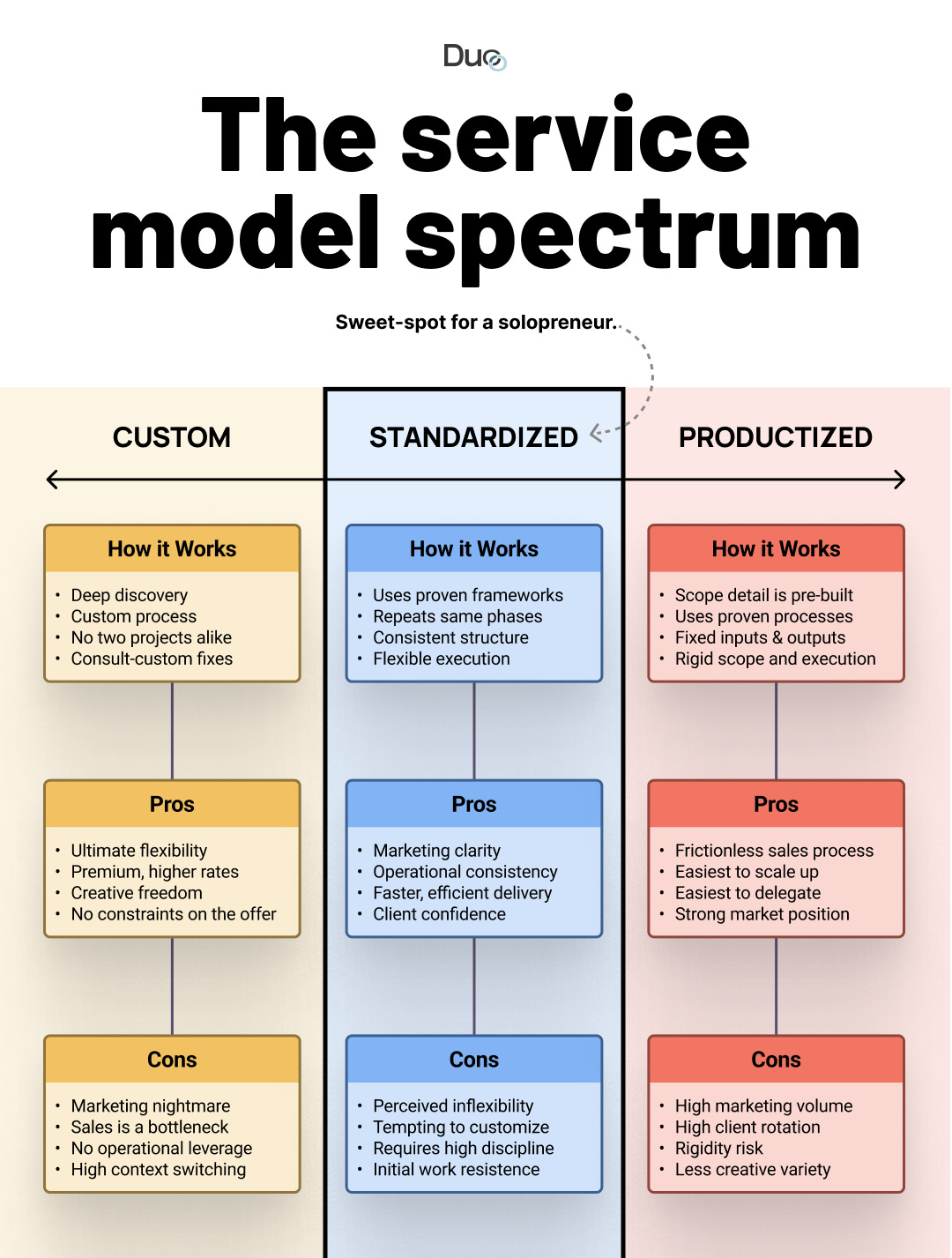
You have a handful of mid-to-high-tier retainer clients, with enough volume to de-risk the portfolio and enough recurring revenue to build on.
The less obvious piece is the pricing logic. Too many solopreneurs assume that charging more is always the right direction. And while pricing power is important and worth building toward, expectations change when you raise rates, and that changes the economics in ways people don’t anticipate.
Let’s say you charge $20K per project per month and can realistically manage one or two clients at that level. The expectations at that price point are significant. Someone charging $10K a month can manage four or five clients with the same time investment, because the expectations are calibrated differently. Four clients at $10K is $40K a month. One client at $20K is $20K. The lower rate produces double the revenue. That doesn’t mean the work is worth less, just that the pricing model allows for more of it.
Now, you can’t charge more and expect everything else to stay the same.
The right pricing isn’t a fixed number. It’s determined by working backward from your goals.
What work do you want to be doing?
What kind of engagements do you want to have?
How many clients can you realistically manage at a given rate?
Does that number, at that rate, hit your target?
If it doesn’t, you rework until it does. You keep updating it as the business grows because your pricing power increases meaningfully once you can manage 10 clients, and 9 of them are already signed. The goal isn’t the highest possible rate or the most clients you can take on. It’s the configuration that produces your number, with enough margin to make the business worth building.
Once you know the economics, you’re ready to design the engagement.
Component 2: The Engagement Model
The engagement model is the four-phase journey every client moves through: Audit, Implement, Optimize, Scale.
You don’t reinvent each phase for each client or custom scope based on what comes up during the first call. You apply the same arc consistently, regardless of who the client is or what they do.
Consistency makes the engagement work. The more standardized the engagement model, the easier it is to optimize delivery, train people to execute it, and eventually delegate pieces of it without the work falling apart.
The four phases look the same across every micro-agency we work with:
Audit. Every engagement starts with a look inside the business. Some clients, like Brad, charge a standalone fee for this phase. Before any retainer begins, he needs to assess the situation. Others, like us at Duo, fold it into Phase 1 without charging separately. The format differs, but the function is the same. Before you implement anything new, you need to understand what’s already there.
Implement. This is where the work happens. Based on what the audit surfaces, you execute against a clear plan. You define deliverables, set timelines, and tell clients what to expect because the engagement model clearly outlines the steps.
Optimize. Once the foundational work is running, you refine it. What’s working? What isn’t? Where are the gaps between what you planned and what’s actually happening? This phase is where you deepen the relationship and deliver strategic value.
Scale. The final phase is about building on what’s been proven. You don’t add more work for the sake of more. You expand what works and position the client for the next level of growth.
One thing worth noting is that the phases sometimes blend together. Optimize and Scale occasionally get treated as a single phase, depending on the engagement. What matters is that every client can see the journey clearly before they start and that you explain it the same way every time.
The other thing we consistently see when working with solopreneurs on their engagement model is that the work isn’t the problem.
Most people already have a process. Our client Brian always ran demand gen the same way. Another client Liam was executing solid work across multiple clients. The problem is that it’s loose, so clients don’t know exactly what’s happening or when. Onboarding is informal, and the phases blur together.
A wide, anything-goes scope makes delegation nearly impossible.
A tight, repeatable one makes it inevitable.
Tightening the engagement model makes what you do legible to your clients and to yourself. Sometimes that means pruning. John came to us with a full-service branding and creative scope bolted onto his positioning work. Liam had scope creep built into nearly every engagement. The pod structure (which we’ll get to in Component 5) is only possible because the scope is narrow and the engagement model is specific.
This makes your micro-agency scalable and easier to market.
Component 3: The Marketing Model
When your engagement model is narrow, marketing gets simpler.
You know exactly what you do, who it’s for, and what problem it solves. That clarity is the raw material for everything that follows. That’s why the marketing model for the micro-agency is MP3: Market the Problem, Market the Process, Market the Proof.
If you’ve read The Recognition Engine mini-book, you already know the framework.
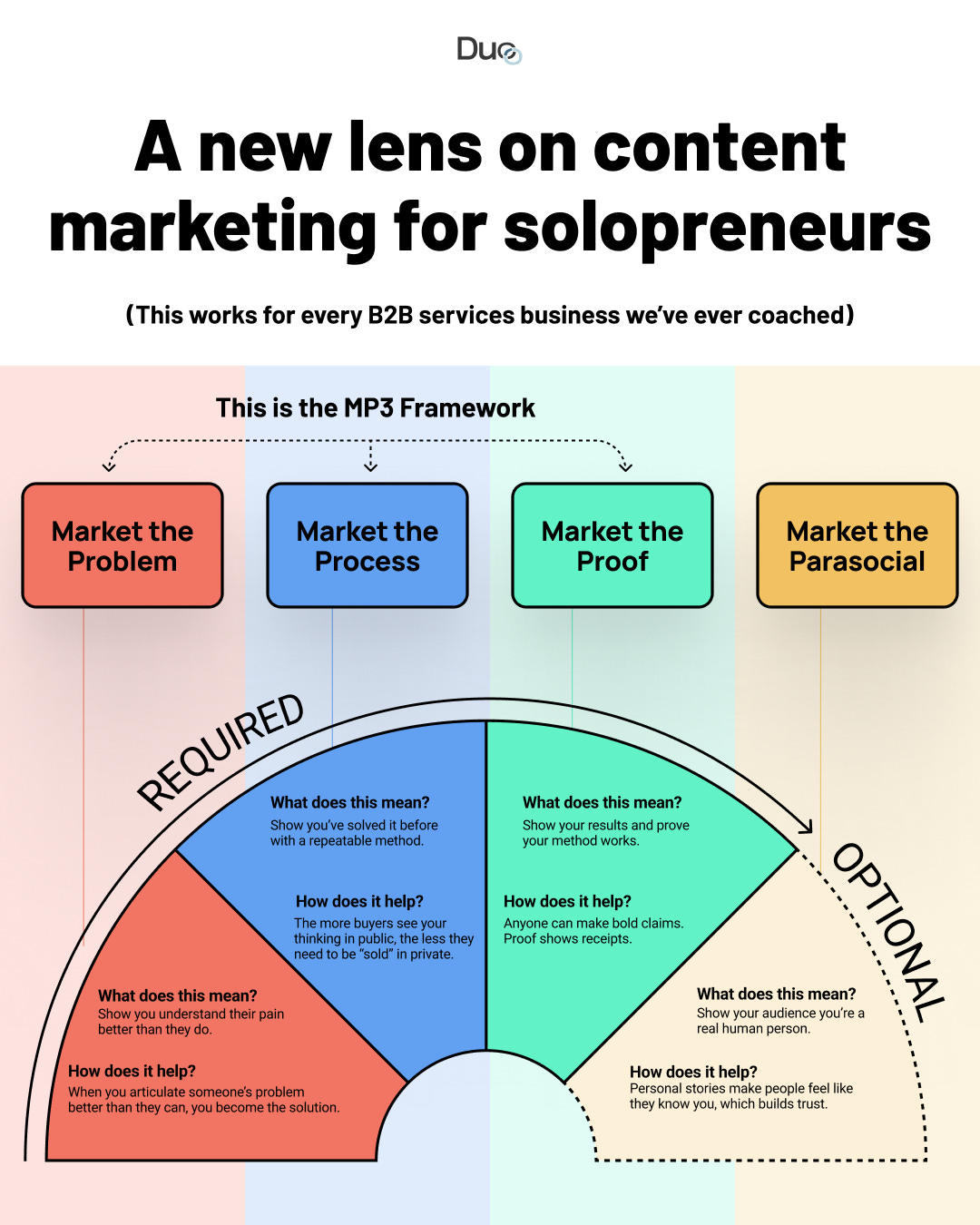
The short version is you don’t market your services. You market the problem you solve, the process you use to solve it, and the proof that it works.
This matters for the micro-agency specifically because the model runs on a finite client roster.
You don’t need to generate hundreds of leads. You need a steady, reliable stream of the right people who already understand the problem, trust the process, and are ready to hire you. MP3 builds that pipeline over time by making you known for something specific rather than recognizable for nothing in particular.
The trap you can fall into here is marketing your services instead of your expertise.
Too many solopreneurs post about what they do, like the tactics, deliverables, and features of the engagement. But high-ticket B2B service buyers don’t buy deliverables. They buy a point of view. They buy confidence that you understand their problem better than anyone else and that you have a repeatable way to solve it.
The marketing copy writes itself when your engagement model is specific, and your problem framing is sharp.
You know what phase of the journey your clients are in. You know what they’re struggling with at each stage. You know what results look like on the other side. Market that consistently, and the right people will find you.
That’s why the micro-agency doesn’t need massive distribution to work.
It needs a consistent, targeted signal.
There’s a difference between traffic marketing and relationship marketing. The first fills the feed, optimizes for reach, and chases impressions. The second builds trust with the right people over time, often in ways that don’t show up in content analytics. The best micro-agency founders we work with are more active in DMs and on calls than in their social media feeds. The MP3 content keeps them visible, while their relationships close new clients.
MP3 belongs in this model because the economics break down without a marketing engine.
A finite client roster only works if you have a reliable way to fill it.
Component 4: The Sales Model
Every seat matters in a micro-agency model.
A bad-fit client at $8K a month is a seat that could have gone to the right client. It’s also a massive drag on the founder’s time and energy, which compounds across the entire business. The sales model exists to protect the roster as much as it exists to fill it.
The framework is the Sales Cascade: direction setting, discovery, pitch, and close.
You want to run it in order, every time, with every prospect. If you’ve read The Service Model Spectrum mini-book, you’ve already seen it in detail. The short version is that if you’re not pitching, you’re helping people buy. There’s a meaningful difference.
Most solopreneurs wing their sales calls.
They vibe with the person, ask questions as they come to mind, customize the pitch based on what they’re hearing, and leave it open-ended. Every call feels different because it is different. The result is a process that doesn’t improve with repetition because there’s nothing consistent to build on.
The Sales Cascade solves this by setting a direction right from the start.
You lead the call with your point of view. You establish what you do, how you do it, and who it’s for before the prospect can reframe the conversation. Discovery is a set of standard questions you run every time, because these are the things you need to know to determine if someone is the right fit. The pitch is the same walk-through of your process, engagement model, and price. The close is a direct question: Is there anything holding you back from getting started?
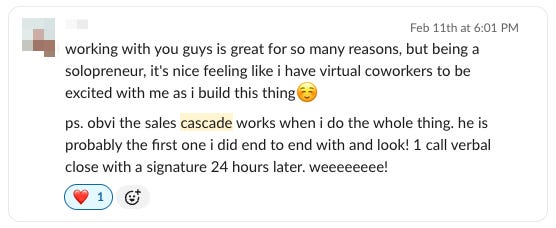
One of our clients (a LinkedIn ghostwriter) knew parts of the Sales Cascade but wasn’t running the whole thing. She’d do some discovery, walk through her offer, and leave the rest for open-ended discussion. Oftentimes, her calls dragged.
But when she ran the full Sales Cascade end-to-end, she got a verbal close for a $36k, 3-month-long contract on the spot.

As a micro-agency, the Sales Cascade keeps you in the sales seat permanently.
One non-negotiable is that you don’t hand off business development. The client relationship starts in the sales conversation, and the person who built it needs to be the one to maintain it. Delegating sales, even in part, is one of the fastest ways to drift from a micro-agency to a traditional agency.
The same rule applies to the fifth component, which is where you get the most leverage.
Component 5: The Delivery Model
Everything in the micro-agency builds toward the delivery model.
This is what makes it possible for you to manage five or six client relationships without doing the delivery work or letting the business fall apart. It’s the component that takes a business from $500K to $2–3M. And it’s the one many solopreneurs either skip or get structurally wrong.
The micro-agency delivery structure, called a pod, has two parts.
The first is the principal strategist, who is often the founder. This person runs marketing, biz dev, and sales, and owns all client relationships. They are the face of the business. They are the reason clients hired the firm. They don’t do delivery.
The second is the delivery team. This is where most people make the mistake. The instinct is to assign one person per account, giving each client their own dedicated point of contact. This feels logical and mirrors how agencies are structured. It’s also, in Nick’s experience, something he’s never seen work. Not even once.
Vertical integration—one person per account who knows the account deeply and owns the outputs—creates single points of failure. When that person is slow, the client suffers. When they leave, the account is at risk. When they get faster, they’re not rewarded for it, so the incentive to improve disappears. The quality across accounts is inconsistent because each person does things their own way.
Horizontal integration works differently. Everyone on the delivery team touches all accounts. Each person owns a task or activity type across the entire client roster, instead of owning everything related to an individual client. So, one person handles graphic design. Another handles marketing. The other handles behind-the-scenes operations. The work stays consistent because the same person does the same type of work across all accounts, which lets them get better at it over time.
The comp structure makes this delivery model scale.
Hourly pay creates the wrong incentives. Someone who’s fast gets paid less per unit of work than someone who’s slow. There’s no reason to be efficient, and every reason to stretch. Flat rate per account removes that dynamic entirely. You pay people a set amount for their contribution to each account, regardless of how long it takes.
Someone who’s faster earns more per hour by default.
Someone who’s slower has an incentive to improve.
You can add accounts without renegotiating compensation.
One of our clients learned this the hard way. He’d built his delivery team vertically, with old coworkers and friends who knew the software well. But they were paid hourly and weren’t interested in working more efficiently. So when he tried to restructure the incentives, they didn’t take the bait. He had to let them go. But he rebuilt using a horizontal-integration delivery model and flat-rate comp, got back into client relationships himself, and saw immediate results. Clients stayed longer, he charged more, and he wasn’t doing delivery work.
The delivery model is the last piece to put in place, but it’s often the most clarifying.
When you see it working, the whole model snaps into focus. The founder manages the relationships. The team handles the execution. Revenue scales because the structure supports it, not because the founder works more hours.
When all five components click into place, you have a micro agency.
One delivery squad, deployed correctly, can take a business from $500K to $2–3M.
Is a Micro-Agency Right for You?
The micro-agency model works if you sell B2B services.
That’s because it prioritizes recurring revenue from a small number of high-value clients. It lets you stay in the work, or at a minimum, stay in the client relationships. It helps you manage people who do the work on your behalf. And it keeps you involved in the marketing and sales side of building a business because those never get handed off.
It’s not the right model if you sell courses, coaching-as-a-product, or speaking engagements.
The micro-agency doesn’t work if you want to build something to exit. It’s designed to produce excellent take-home income for the person running it.
It’s not structured to create enterprise value for a buyer.
It doesn’t work if you want to be the product through coaching, speaking, or content because those businesses scale differently and require a different business model.
It doesn’t work if you want creative variety across every engagement, because standardization is the engine, and that requires discipline to maintain.
And it doesn’t work if you want to own the business without running it, because the founder’s presence in the client relationship is non-negotiable.
This isn’t a model for traditional agencies or creators.
A micro-agency is for the B2B service seller who wants to go from $20K months to $200K months without their business becoming something they resent.
The people we work with who build this well tend to know why they don’t want to build an agency. That clarity matters. One of our clients, Brian, spent years running demand gen inside tech companies and at an agency before going out on his own. He understood the mechanics of a services business and knew exactly what he didn’t want to replicate. That background gave him a head start. Not everyone has it, and that’s fine.
Knowing what you’re building toward, and what you’re deliberately not building, keeps the model intact as your business grows.
A micro-agency is the architecture, but you also need guardrails.
Every founder building a micro-agency has internalized certain boundaries. These are the lines that, once crossed, quickly change the business. Stick to them, and you’ll never become a traditional sh*tty agency:
You keep the client relationships. You don’t hand off accounts. Client communication is the last thing to hand off, not the first. The moment someone else owns the relationship, you’ve become an account manager at your own business. The data on this is unambiguous: clients who stay longest are almost always the ones the founder manages directly. Retention lives in the relationship.
You keep the sales. You don’t delegate biz dev. Sales is where the client relationships begin. The founder who built that relationship needs to be the one maintaining it. Handing off sales, even partially, is one of the fastest ways to drift toward a more traditional agency model.
You stay recognizable for one problem. You don’t diffuse into a generalist shop. The marketing model, the sales model, and the engagement model all depend on a clear, specific problem you’re known for solving. Start saying yes to adjacent work that doesn’t fit, and the positioning erodes. This makes everything downstream harder.
You scale leverage, not headcount. More revenue doesn’t require more people. The pod structure is designed to add capacity without adding management complexity. The moment you start growing the team to grow revenue, you’ve changed the model’s fundamental economics.
Building a micro-agency means building your business deliberately.
So, we want to leave you with a question most business advice skips.
What’s “Enough” For You?
Too many solopreneurs operate on a subconscious assumption that more is always the right direction. It’s baked into the culture. Tony Robbins says if you’re not growing, you’re dying, and whether you’ve heard that exact quote or not, you’ve probably internalized some version of it.
It’s the idea that staying where you are is failure in slow motion.
We’ve wrestled with this “to grow or not to grow” question ourselves.
When we hit our revenue goal, a number we’d been working toward for almost a year, the feeling wasn’t what we expected. It was…strange. Almost uncomfortable. And we immediately asked ourselves, “Do we just cruise, or do we keep growing?”
Neither of us had a clean answer, because we’re wired to keep pushing.
A lot of solopreneurs have “more” as an implicit destination. But they never stop to ask what “more” means, if it’s something they truly want, and whether the version of “more” they’re chasing will produce the outcome they’re after.
So we’ll ask you now: What version of business do you want?
A micro-agency requires an honest answer to the question “What are you optimizing for at this stage of your business and your life?”
That answer will drive every decision about pricing, team structure, and how far to push.
Get clear on that, and everything else becomes easier to calibrate.
Cheers,
Nick, Erica, & Katrina
P.S. – Ready to speed up the transition from consultant to real company? Book a call with Nick and Erica.
P.P.S – Want to share your unique POV with mini-books like this one? Book a call with Katrina.
Have questions? Ask us in a comment below.
The horizontal vs vertical staffing approach is gold.
I’ve seen the vertical approach play out with mixed results in multiple agencies that I have been a part of.
I’ve had an intuition for the horizontal approach, but didn’t have the language to describe it.
Great read!
Love this. That’s the kind of business I proudly run.