



Welcome to How Solos Scale. Each week, we share a new framework, concept, or example of how solopreneurs are scaling from $35,000 to $80,000+ per month.
Hey there,
A client we work with (let’s call him Joe) has over 40,000 followers on LinkedIn.
Most people in the B2B SaaS marketing world know his name. When he posts, people pay attention. When he announces he’s taking on clients, his DMs fill up.
From the outside, he looks like he’s winning. And in many ways, he is.
But nobody sees that his sales calls follow the same pattern:
Prospect: “Hi, Joe. We have a content problem. Can you help?”
Joe: Asks thoughtful questions. Digs into their specific situation. Identifies their unique challenges.
Prospect: “So what makes you different from the agencies we’ve talked to?”
Joe: Explains his approach. Customizes the pitch based on what he just learned. Differentiates based on his background and philosophy.
Prospect: “Can you put together a proposal for us?”
Joe: Custom-scopes a strategy for the prospect’s exact situation.
Repeat.
Repeat.
Repeat.
Every client scope is unique, custom, and built from scratch. Because that’s what consultants do, right? You understand the client’s unique situation, you build a strategic solution, and you deliver it. That’s the game.
Except Joe’s stuck at a Revenue Wall of $50K/month and can’t figure out why.
The Custom Scoping Trap
When you’re stuck in custom scoping, it manifests as different problems depending on where you look.
“I need to explain my approach better.”
“I need to charge more for this level of customization.”
“I need better systems so I can manage more clients.”
“I need to hire help, so I’m not the bottleneck.”
“I need better clients who understand the value.”
Those are legitimate problems, and they all ladder up to a larger problem.
The Custom Scoping Trap is when you build a unique solution for every client because it feels like good service. But in reality, customization makes it impossible to standardize, delegate, automate, and scale.
If you’re reading this and thinking, “Oh sh*t, that’s me,” you’re not alone.
The Custom Scoping Trap gets the best of us because you feel like you’re doing the right thing:
You pride yourself on understanding each client’s unique situation.
You’ve been trained to be strategic, and strategy feels like customization.
You don’t want to be the person pushing templates and cookie-cutter solutions.
Custom scoping works (you can actually get to about $50K/month this way).
Each custom solution feels like proof that you’re thoughtful and thorough.
That’s why custom scoping is a feature until it becomes a ceiling. It works when your business is small, but it traps you when you try to grow. This usually hits somewhere between $20K and $50K per month—right when you think you’ve figured it out.
Once you realize you’re stuck in custom scoping, your first instinct is usually something like:
“If I just make my service more like a product, I can escape.”
You look at companies running sprints with fixed deliverables. You see the appeal of cohort-based courses and their seemingly frictionless sales, maximum efficiency, and easy scalability.
But productization isn’t the only option.
And for most solopreneurs, it’s not even the right option.
We’ve spent years working with hundreds of solopreneurs who’ve been custom-scoping for every client. We’ve tried different service models ourselves. We have a clear position on this.
A standardized service model works best for most solopreneurs looking to scale their recurring-revenue business.
In this mini-book, we’ll explain the three main service models, show you the tradeoffs, and explain why we build standardized businesses (and why we think you should too).
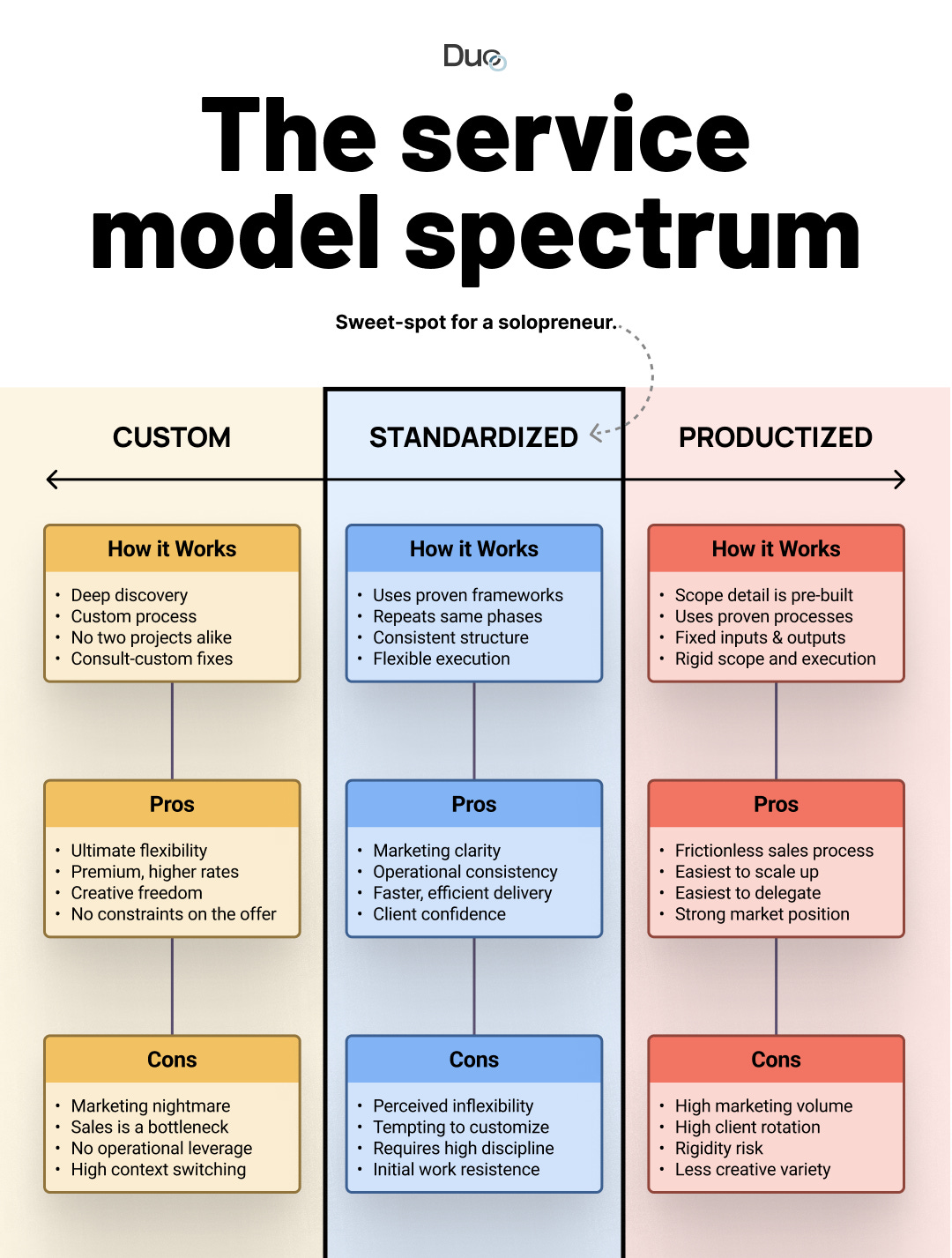
The Service Model Spectrum
There are three ways to structure a service business:
Custom Services - Fully bespoke work where every engagement is built from scratch
Standardized Services - A proven methodology applied in different orders to different client situations
Productized Services - Assembly-line delivery where every detail is predetermined
All three models can deliver exceptional quality. The main difference comes down to the operating model.
Custom works when you can charge premium prices and only need a few clients per year.
Standardized works when you want recurring revenue and sustainable scale.
Productized works when you have massive distribution and can maintain high volume.
Think of it like the three different ways to experience exceptional food:
Custom = Private Chef. A renowned chef comes to your home and creates a custom experience. They design the menu around your preferences, source ingredients, and cook something entirely unique. It’s the highest level of personalization and premium pricing. The limitation: They can serve only a few people because each meal requires their full attention.
Standardized = Signature Restaurant. A restaurant where the same renowned chef has perfected their signature dishes. The menu is curated—you’re not getting a custom meal—but the chef will adjust for dietary needs. The dishes are proven, the experience is refined, and the quality is consistently excellent. The restaurant can serve more people per night because the process is dialed in.
Productized = Prix Fixe Menu. A restaurant where the same renowned chef offers a tasting menu. Seven courses, zero substitutions, and the same progression for every table. It’s refined to perfection and on a specific timeline, which requires absolute consistency. The limitation: The restaurant needs to fill most seats every single night to make the economics work, which is why this level of refinement only makes sense at a certain volume.
All three can be premium. The difference is the business model, not the quality.
Now, let’s break down each model in detail.
Model 1: Custom Services
In a custom service model, every engagement starts with a blank page.
The appeal is that you can say yes to almost anything. You have pricing flexibility and creative freedom. You’re responsive to each client’s needs. Every project is a new challenge and learning opportunity.
But you’re also agreeing to the tradeoffs:
Marketing is a b*tch. How do you explain what you do when it changes every time?
Sales is exhausting. Every prospect needs extensive discovery. Every proposal is built from scratch.
Scoping is time-intensive. Clients get highly personalized solutions tailored to their exact situation.
Scoping risk is high. When you’ve never done this exact thing before, it’s easy to underestimate how long it takes. You promise three months, and if it takes five, you eat the loss.
You can’t get efficient. There’s no repeatable process because you’re always doing something slightly different.
You can’t delegate. What would you even hand off? We’ll say it again: There’s no repeatable process.
Capacity is your ceiling. Revenue grows by taking on more clients or raising rates, but capacity quickly becomes the ceiling.
Custom-scoping works, of course, but only under specific conditions:
You solve one expensive problem.
You charge a high premium rate
You take on one or two engagements at a time
If someone comes to you with a problem so big and so specific that you’d quote them a number that makes the scope worth your while, that’s a valid business model.
But custom work has a ceiling.
Most often, we see solopreneurs custom-scoping work around $5-$10K. That’s not nearly premium enough for custom work. They have all the same drag (discovery calls, custom pitching, scoping risk), but none of the financial upside that makes it worthwhile.
This is why our client Joe is stuck. He’s doing great work, but every project is a custom build. He’s at his client capacity, and it’s keeping him trapped.
Model 2: Standardized Services
A standardized service is a structured methodology with a consistent process but flexible execution.
Instead of custom-scoping every project, you have a proven process for every client. The puzzle pieces may fall in a different order (depending on client needs), but they are the same every time.
The audit always includes the same components
The deliverables have the same structure
The timeline and order of operations might flex, but it’s the same standardized process every time.
Of course, every model has unique challenges:
Perceived inflexibility: Some prospects will push back, “But our situation is unique.” They want fully custom solutions even when a proven process would serve them better.
Temptation to customize: Clients may request scope changes that break your standardization. When they ask for something outside your process, you have to decide: Does this improve the process for everyone, or is this scope creep?
Requires discipline: You must resist the urge to say yes to everything or rebuild from scratch each time. It takes consistent effort to hold boundaries and maintain the process.
Psychological resistance: It may feel like you’re “giving less” when the work becomes easier. But efficiency is the point. Clients pay you because it’s easy for you, not because you bleed for it.
Standardization works best when you want recurring revenue, multiple clients simultaneously, the ability to delegate and scale, and to refine your expertise over time.
Think about it: Would you rather hire a surgeon who’s done your procedure 500 times with a refined process, or one who custom designs the surgery every time?
In our opinion, the proven process is a feature, not a bug.
Model 3: Productized Services
A productized service is an assembly-line delivery model in which every decision is predetermined.
You’re offering a refined, proven system that produces consistent results. Every client knows exactly what they’re getting before they pay. There’s a discovery process, but it’s less about “What am I buying?” and more about “Is this right for me?”
This comes with advantages:
Marketing is clear. “I walk you through a two-week positioning sprint for B2B SaaS for $10K. Here’s what’s included.” Super simple.
Sales feels easy. There are no custom proposals. No negotiations. No “can we add another workshop?” You don’t need to scope anything; just send potential clients to your sales page.
You get really efficient. You know every potential obstacle. You’ve optimized every template. You know exactly how much time and effort each sprint takes. By sprint 20, you’ve cut the time in half.
Delegation is straightforward. Every sprint follows the same playbook. You can train someone to run it.
And disadvantages:
If we use the $10K/sprint example, here’s the math reality:
To make $20K/month, you need 2 clients per month
To make $50K/month, you need 5 clients per month
To make $100K/month, you need 10 clients per month
That’s 10 new clients every single month.
Because productized services are typically projects, they have a beginning and an end. There’s no recurring revenue. Every month, you start from zero.
Compare that to a standardized retainer: 5 clients at $10K/month = $50K/month.
Those same 5 clients might stay for 6–12 months. You need 5–10 total clients per year, not 60+.
The tradeoffs are significant:
Marketing dependency is constant. The entire business depends on consistent demand generation. If you have a slow month, your revenue tanks. You need a constantly full pipeline to survive.
Rigidity can lose deals: Some buyers want flexibility. When they ask, “Can we customize this?” and you say no, you might lose the deal.
Efficiency requires volume: Your optimized delivery only matters if you can maintain high volume. You need high volume to justify hiring, which means you’re dependent on constantly filling the pipeline.
Positioning is locked in: You’re betting everything on this one offer. If the market shifts or demand dries up, you’re stuck.
Productization works best when your business is mature with proven demand generation, you’re known for solving one specific problem exceptionally well, you have systems to keep top-of-funnel consistently full, and you’ve tested and validated the exact offer extensively.
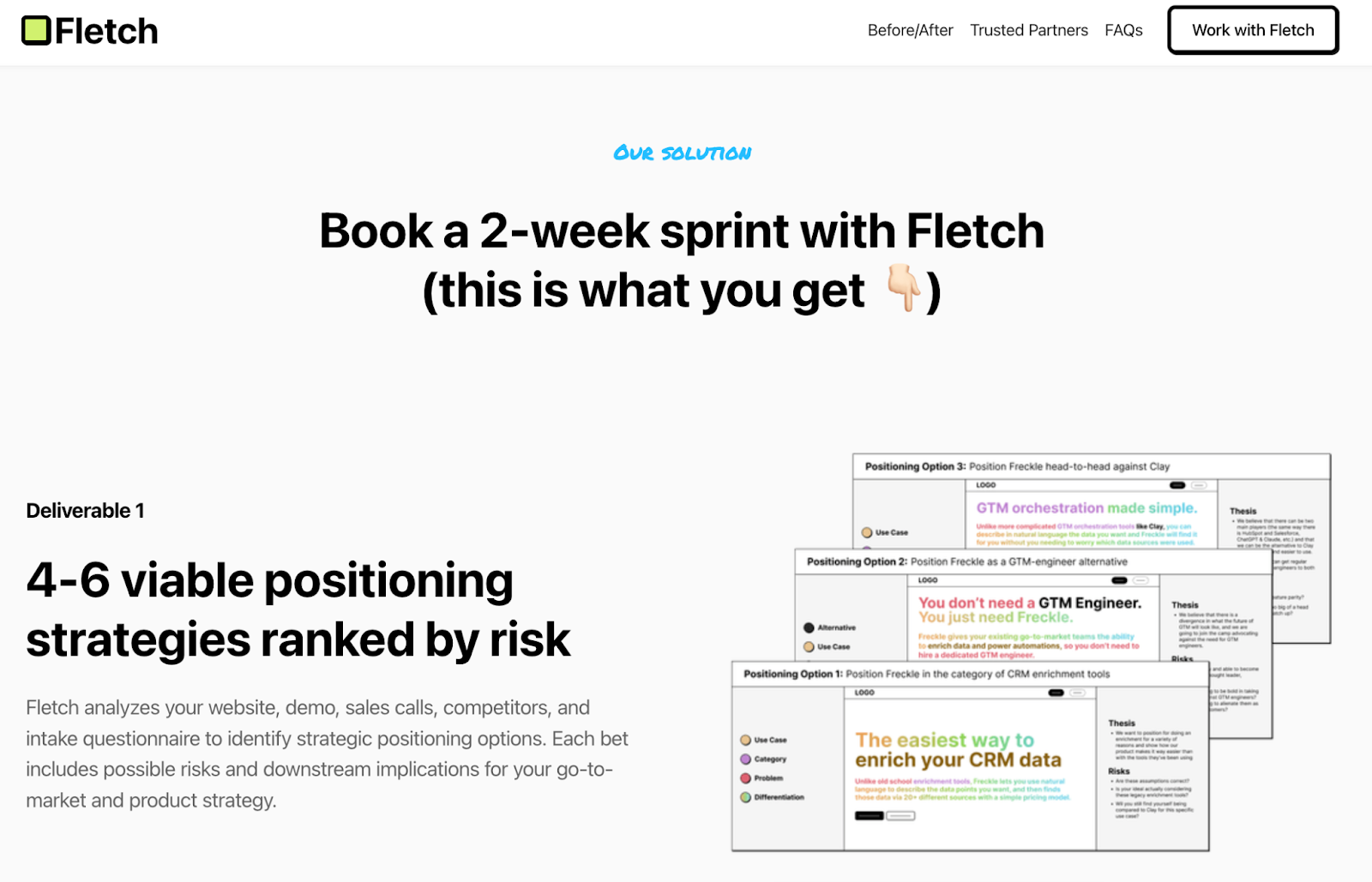
FletchPMM uses this model for its positioning sprints.
Our friends Anthony Pierri and Rob Kaminski run a product marketing consultancy for B2B software companies called Fletch.
(We’ve interviewed them on this show before. You can check that out here.)
They offer positioning sprints with a fixed 2-week timeline. The deliverables are always the same three things: 4-6 positioning strategy options, a 6-slide internal deck, and a homepage wireframe with production-ready copy.
The process uses pre-determined workshops at predetermined times. The pricing is fixed tiers based on company size: $10K for early stage, $20K for growth stage, and $30K for mature.
Buyers already know what they’re getting, what it costs, and what they’ll walk away with. There’s no gray area to work through. The call is just the last step before yes.
This is productization at its finest, and it works for a few reasons.
They have massive distribution. Founders Anthony and Rob are both well-known in the B2B SaaS world. They create tons of content. They have large, engaged audiences.
They’ve proven demand. Over 500 positioning projects completed. They’re not hoping it works. They know it works because they’ve done it hundreds of times.
They can maintain the volume. To make productization work at their price point, they need to run multiple sprints per month, every month. And they can. The pipeline stays full because of their distribution.
They’ve refined it to perfection. After 500 projects, they know every potential obstacle. Every framework is optimized. Every workshop is dialed in. The efficiency is undeniable.
People look at successful productized services and think, “That’s what I should do!”
But they don’t realize the demand generation required to make it work.
They launch the sprint. They close 2–3 clients. Then the pipeline goes dry. They panic and start customizing to win deals.
Suddenly, they’re back in custom scoping with a productized price.
A Case for Standardized Services
As you move from Custom → Standardized:
Marketing gets easier (clearer positioning)
Sales get easier (less discovery needed)
Delivery gets easier (more operational leverage)
Revenue gets less stable (requires more lead volume)
All three models can work, and all three can be premium.
The question isn’t: “Which is better?”
It’s: “Which matches the business you’re trying to build?“
You can market a clear process without being rigid.
If you want recurring revenue, multiple clients, and sustainable scale without needing massive distribution, standardization is the sweet spot.
Here’s why:
When your service is standardized, prospects know what they’re getting.
You can explain your methodology. You can show your framework. You can demonstrate your process. But you still have flexibility in execution. The process is the same, the outcomes are custom.
This means you’re not stuck explaining, “Well, it depends on your situation,” on every sales call.
You have a clear answer to, “What do you do and how do you do it?”
One of our clients, let’s call him Tom, used to struggle with this. He’d get on sales calls and customize his pitch based on what he heard. Every conversation was different. Every proposal was different. Buyers were confused about what they were actually buying.
Once we helped him standardize his offer—Audit, Launch, Optimize, Scale—everything changed. Buyers could see the journey. They understood the deliverables. They knew what to expect.
His close rate went up because he stopped trying to be everything to everyone.
You can refine your delivery over time.
You spot patterns, see what works across clients, and eliminate what doesn’t.
With custom work, you’re always starting from scratch. With productized work, you’re locked into a rigid system. With standardized work, you have a foundation you can continuously improve.
That’s how you improve and scale simultaneously.
You can delegate and automate.
With a standardized service, there’s enough consistency to train someone else and enough flexibility to handle variations without a huge team.
One of our clients, Brian, was drowning in delivery. He had contractors helping him, but he was still the bottleneck on every project because nothing was standardized.
We helped him build a standardized engagement process with clear phases, deliverables, and handoffs.
Suddenly, his contractors knew exactly what to do.
He could step back from execution and focus on strategy and sales. His capacity doubled without working more hours.
Yes, you can delegate productized work, but you need high volume to justify the team.
It optimizes for recurring revenue.
Most productized services are projects, meaning they have a beginning and an end. That’s why you need constant new client acquisition.
Standardized services work beautifully as retainers.
You’re solving a recurring problem through a consistent process.
Clients stay longer. Revenue is more stable. You don’t need to close 10 deals a month to hit your targets.
Would you rather have 5 clients paying you $8K/month for 12 months, or need to close 50+ project clients throughout the year to hit the same revenue?
The math is clear. Recurring revenue is more sustainable.
Your sales process becomes easier.
When you have a standardized service, your sales process standardizes too.
You ask similar discovery questions.
You pitch the same process.
You set consistent expectations.
You’re not custom-building a pitch for every prospect.
You’re teaching people how to buy from you, not convincing them you’re worth considering.
One of our clients is a LinkedIn ghostwriter. She started working with us in December and, like most solopreneurs, she’d been on sales calls before. She knew parts of the sales cascade we teach. She just wasn’t running all of it.
She’d do some discovery, walk through her offer, and get a feel for the person on the other end of the call. But she’d improvise through the middle, skip the close, and leave wondering why things felt so drawn out.
We told her to run the full sales cascade (direction-setting, discovery, pitch, close) in order every time. The next call, she ran it end to end. She got a verbal close on the spot and a signature 24 hours later.
Her message to us:

The process was never the problem. It was the discipline to follow it every time, not just when it felt natural, or the call was going well.
A standardized sales process gives you a repeatable play that gets simpler and stronger every time you run it.
It also gives you:
Enough structure to scale efficiently
Enough flexibility to handle client nuance
Clear methodology that’s easy to market
Repeatable process that compounds your expertise
Sustainable business model that doesn’t require massive distribution
We’re not saying productization is wrong or that custom work can never succeed.
Custom and productized service models can work, but both require conditions most solopreneurs don’t have:
Premium pricing that justifies the hassle
Massive distribution that keeps the pipeline full
If you’re building a recurring revenue business without either of those things, standardization is the path that works best for scale.
The 4 Pillars of Standardization
The process requires standardizing four things:
Your offer (what you sell)
Your marketing (how you make it visible)
Your sales process (how you sell it)
Your engagement process (how you deliver it)
You need all four pillars because they overlap and bleed into each other. Fix one without the others, and you’ll stay trapped in custom scope hell. But standardize all four, and you’ve built a business that can scale.
Let’s break down each one.
Pillar 1: Standardize the Offer
Without a standardized offer, everything else falls apart.
Your standardized offer is the clearest articulation of:
What problem you solve
Who you solve it for
The process you use to solve it
Here’s a quick test: Can you say no to work that doesn’t exactly fit your offer?
If you’re still saying “yes” to almost everything and adjusting your approach based on each client’s unique situation, your offer isn’t standardized.
A standardized offer means:
You solve ONE specific problem (not “I can help with content” but “I help B2B SaaS companies create SEO-optimized content in order to drive traffic to their websites”).
You have a defined process (repeatable steps, not a custom strategy every time).
You know who it’s for and who it’s NOT for (and you’re willing to turn down bad fit prospects)
If you’re going “uh oh, I don’t have any of this figured out, go read this.
Pillar 2: Standardize the Marketing
Once your offer is clear, you need to make it visible to the right people.
Standardized marketing means your content directly connects to your offer. This is where the MP3 framework comes in: Market the Problem, Market the Process, Market the Proof.
Market the Problem: You write about the specific problem your offer solves (not related problems, not interesting topics, THE problem)
Market the Process: You share how you solve it (your methodology, your approach, your POV)
Market the Proof: You show it works (case studies, results, examples)
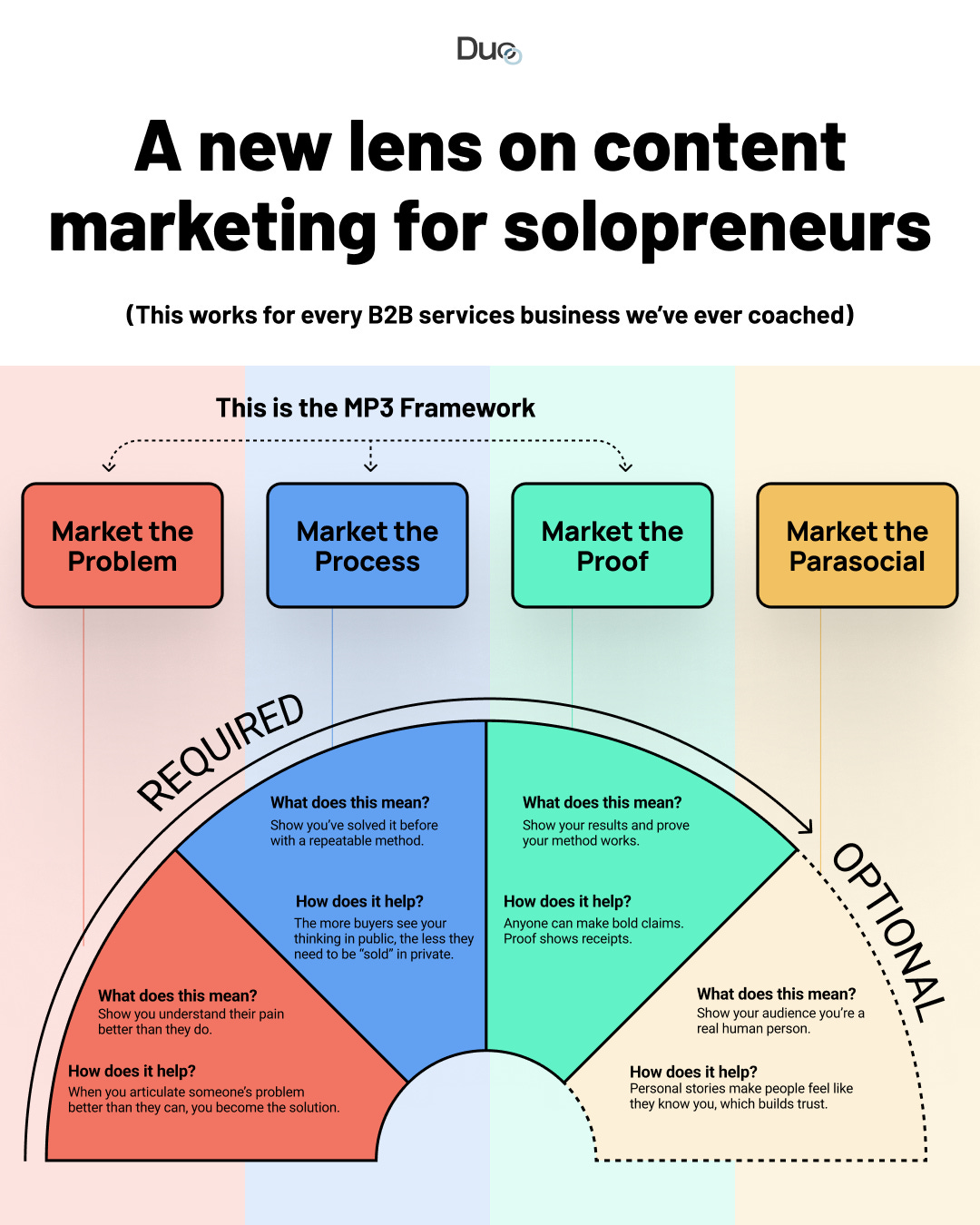
When your marketing is standardized, people come to your sales calls already knowing what problem you solve, how you solve it, and that you can actually solve it.
Pillar 3: Standardize the Sales Process
This is where most consultants completely wing it.
You get on a call. You vibe with the person. You ask questions as they come to mind. You explain your approach based on what you’re hearing. You customize your pitch. You leave it open-ended.
Every call is different because you’re making it up as you go.
But a standardized sales process has structure—the same structure, every time.
Direction Setting: You lead with your point of view. You help them see why your approach is categorically different. You set expectations for what you do and don’t do. (Not: “Tell me about your situation, and I’ll figure out how I can help.”)
Discovery: You ask the same core questions every time: What motivated this call? What have you tried? What are your goals? What’s your timeline? What’s your budget? These questions should be standardized. Not because you’re being robotic, but because these are the things you NEED to know to determine if someone is a fit.
The Pitch: You walk through what you do, how you do it, what the engagement looks like, and how much it costs. The same way, every time. You’re teaching them how to buy from you—not customizing a solution on the fly.
The Close: You ask: “Is there anything holding you back from getting started?” When you ask this, you’d be surprised how honest people are. They’ll tell you their real objections: “I need to talk to my business partner first,” or “I’m not sure about the timeline,” or “The price is higher than I expected.” Now, you can address the objections instead of guessing why they went silent after the call.
When you standardize your sales, you go from custom pitches to a repeatable conversation that qualifies and converts.
Pillar 4: Standardize the Engagement Process
You can have a clear offer, clear marketing, and a clear sales process.
But if your engagement process isn’t standardized, you’ll revert to custom scoping the moment a client asks for something outside your scope.
Here’s how it usually happens:
You’ve sold a standardized offer. The client is excited. You kick off. And then they say: “Can we also look at [thing that wasn’t in the scope]?”
Or: “I know we talked about X, but what we really need is Y.”
Or: “This is great, but can you customize it for our specific situation?”
And because you want to be helpful, because you want them to succeed, because you don’t want to seem rigid—you say yes. But then you’re back to custom-scoping the delivery, even though you sold a standardized offer.
A standardized engagement process means:
You have a roadmap - The same steps, every time. Not “let’s see what you need” but “here’s the process we’re going through together.”
You have clear deliverables - What they get, when they get it, how you deliver it. All defined up front.
You have boundaries - You know what’s in scope and what’s not. And you’re willing to hold those boundaries.
You have a curriculum - The frameworks, the exercises, the milestones. They’re the same for every client because they’re proven to work.
A lot of solopreneurs think standardization means cookie-cutter.
It doesn’t.
We run the same play with all our clients. We use the same process, the same roadmap, the same deliverables. But every client’s outcome is different. Every offer we help them create is unique. Every piece of content they produce is original.
The process is standardized, but the outcome is custom.
That’s the difference between standardization and custom scoping.
Why Standardization Unlocks Everything
All four pillars work together. Miss one, and you’ll keep slipping back into custom scoping.
Clear offer, but unclear marketing? People will come to you asking for the wrong thing, and you’ll custom-scope solutions.
Clear offer and marketing, but no sales process? You’ll customize your pitch on every call and end up with misaligned expectations.
Clear offer, marketing, and sales, but no engagement process? You’ll say yes to scope creep and custom requests because you don’t have boundaries.
You need all four, but you don’t have to fix them all at once. You can tackle them sequentially. In our experience working with dozens of solopreneurs, here’s what we typically see:
Most people start with the offer. They get clear on what they sell. This feels like progress, and it is. But then they’re frustrated when they’re still custom-scoping everything.
Then they fix their marketing. They start creating content that actually connects to their offer. More qualified people start reaching out. But sales calls are still exhausting.
Then they standardize sales. They build a repeatable process for their calls. Clients come in with clear expectations. But delivery still feels chaotic.
Finally, they standardize engagement. They build the roadmap, set the boundaries, and create the curriculum. And suddenly, they can scale.
Once your engagement process is standardized, you can delegate because there’s a consistent process to hand off.
You can automate because tasks are repeatable.
You can improve because there’s a process to optimize.
You can prove value faster because time-to-value improves with every iteration.
The more you run the same process, the better you get at it.
You spot patterns, refine your approach, eliminate what doesn’t work, and double down on what does. This is when you go from custom scoping every project to running a proven process for every client.
This is when automation and delegation become possible.
And when you go from “at capacity” to scaling with purpose.
Cheers,
Nick, Erica, & Katrina
P.S. – Ready to standardize your custom consulting services? Book a call with Nick and Erica.
P.P.S – Want to share your unique POV with mini-books like this one? Book a call with Katrina.
Have questions? Ask us in a comment below.
This really nails the “custom scoping as a ceiling” problem so many experts and solopreneurs quietly run into. This made me think about how often we mistake personalization for value, when the real unlock is a standardized backbone that still delivers custom outcomes for the right customers. I find this especially engaging because the way you connect offer, marketing, sales, and engagement makes it obvious that standardization isn’t just an ops choice, it’s a filter for who you serve, how you sell, and whether your “dream business” is even structurally possible.