



Welcome to How Solos Scale. Each week, we share a new framework, concept, or example of how solopreneurs are scaling from $25,000 to $50,000+ per month.
Hey there,
One of the first questions we ask every solopreneur we work with is simple:
What are your goals?
You’d think that would be an easy one to answer. These are people who built something from scratch. They’ve landed clients, grown revenue to $35K+ months, and figured out how to make it work without a boss, a safety net, or a huge team. They’ve made thousands of decisions to get to where they are.
But almost every time we ask about goals, they pause and say something like:
“That’s a good question. I honestly don’t know my goals. I probably should have a better answer than that.”
We heard it again recently from a client, an event planning consultant doing $38K a month. She is fully booked with clients who love her, and referrals are coming in faster than she can respond. By any reasonable measure, she’s crushing it.
But something is off.
She admitted that she just feels... aimless.
Like she’s waking up every day, doing the work to get to Friday, and following the motions week after week. The business is going, and she’s along for the ride. She just can’t tell you where she wants to go or what she wants to accomplish in the long term.
When we dug in, we found she hadn’t made a directional decision about her business in years.
She’s capable of creating a vision, but she’s never done it.
Instead, most of her decisions are in response to something. She gets a client request, an opportunity shows up, or she sees a gap in the market. She’s good at spotting these things, and she moves fast on them.
Responding to opportunities is part of running a business.
The problem is that’s all she’s doing.
She’s built a thriving business. She just hasn’t chosen where it’s going, which means she has no way to know which opportunities deserve a yes.
This is the Passenger Problem.
The Passenger Problem is when you build a successful business without ever deciding what you’re building toward.
You react to opportunities instead of directing your business toward a chosen destination.
You’re not making bad decisions. You’re just making them in response to things, rather than toward a vision.
The questions driving your decisions sound like:
“What does this client need?”
“What’s the next logical service to offer?”
“How do I keep what I have going?”
These are all external forces (market demand, client requests, and what success is supposed to look like).
Contrast this with internal forces (where you want to be in 2-5 years, what your ideal day looks like, what kind of business model gives you energy).
The questions sound different:
“What matters most today toward the business I’m building?”
“What can I say no to because it doesn’t serve my vision?”
“What moves me closer to where I want this to go?”
In this scenario, your decisions (even the small ones) orient toward your vision.
As a passenger, you wake up and do. As a driver, you wake up and decide.
If you recognize yourself in the Passenger description, know you’re not stuck there.
In fact, the Passenger Problem affects solopreneurs and micro agency owners who are doing almost everything right. The shift requires understanding how you became a Passenger and what to do to become a Driver.
In this mini-book, you’ll learn:
Why being reactive got you here and why it can’t get you further. The strategy that built your business to $35K+/month is the same one keeping you stuck. We’ll show you how this happens and why successful solopreneurs are the most vulnerable.
The cost of staying in passenger mode. It’s not just feeling aimless. We’ll walk through what happens when you push to $50K, $70K, or $100K/months without ever choosing where you’re going and why the crash gets uglier the higher you climb.
How to shift from responding to directing. You don’t need a five-year plan or perfect clarity. You need to answer a few specific questions that most solopreneurs have never asked themselves. We’ll share what those are and how to think through them.
Let’s start with how solos end up in the Passenger seat.
Why Solos suffer from the Passenger Problem
At the beginning of a new business, being reactive is the strategy.
You put things out into the world, see what lands, and follow the signal for what works. You build a reputation by being responsive and grow revenue by saying yes to opportunities. You prove your value by solving problems for people.
This strategy works for a while, and most solopreneurs get really good at it.
That’s the trap.
Every reactive decision reinforces the Passenger Problem.
When every decision is reactive, you have no filter. You can’t tell the difference between an opportunity worth taking and one that feels urgent. You say yes to things because they make sense in the moment, not because they move you toward something. And when opportunities are everywhere at once—which they will be, the better you get at what you do—you have nothing to stay grounded in. You just hop from one thing to the next.
A vision makes you more discerning. You can still move fast on the right things, but you know what “right” means.
For example, one of our clients (we’ll call him John) came to us doing $40K months. By most standards, he’d made it. He’d replaced his corporate salary, built a roster of happy clients, and had more work than he could handle. He was also working 60-hour weeks and doing everything himself.
When we asked him about his goals, he shrugged and said, “I might just go back and get a job. I don’t know. Whatever.”
He wasn’t joking.
He’d been running this way for a year and a half, but he had no idea where any of it was going. When his friends would ask, “Where are you taking this?” his answer was honest: “I don’t know. I’m just doing stuff.”
That’s what passenger mode looks like at scale. You’re not struggling or failing. You’re just... going.
The longer you go without choosing a direction, the more it feels like the only way out is to stop entirely.
As a Passenger, you begin to resent your business.
You look at what you’ve built and think: “This was supposed to give me freedom.”
Instead, you’re more trapped than you were in a corporate job. The exhaustion isn’t from the work itself. It’s from doing work that doesn’t feel like it’s taking you anywhere.
We’ve watched solopreneurs at every revenue level struggle with this problem.
They think the feeling will go away if they push a little harder, grind a little more, and optimize. (These are all limiting beliefs.) You can’t systematize your way out of not knowing where you want your business to go. You can’t hire a VA to figure out your vision. You can’t automate the decision of what you’re building toward.
You have to take the wheel and steer your business.
The cost of staying in Passenger mode isn’t plateauing—it’s burning out at a high speed.
If you push to $70K as a passenger, you crash at $70K. If you push to $100K, you crash at $100K. The outcome gets uglier the faster and higher you grow.
So what changed for John, who was directionless at $40K months?
We walked him through a series of questions he’d never been asked before:
What do you want from this business?
If you went back to a job, what would that look like? What would you be giving up?
If you continued building this business, what would that look like? How do you build something you don’t want to escape from?
He didn’t have answers right away (most people don’t). But when he started thinking about those questions seriously for the first time, he realized he’d been treating his business like a placeholder. It was a temporary thing he was doing until he figured out what he really wanted to do. He’d been doing it for a year and a half, so it wasn’t temporary anymore. He’d just been treating it that way.
His approach was the problem.
Once he saw that, something switched.
Within a week, he hired three people: 1) an assistant to handle his inbox, 2) contractors to take over the button-clicking work he’d been drowning in, and 3) someone to manage the tactical prep that was eating his time.
FYI: This level of speed is abnormal. John has a supercharged bias toward action. It’s unlike anything we’ve ever seen. He sent us this a few days after our first call:
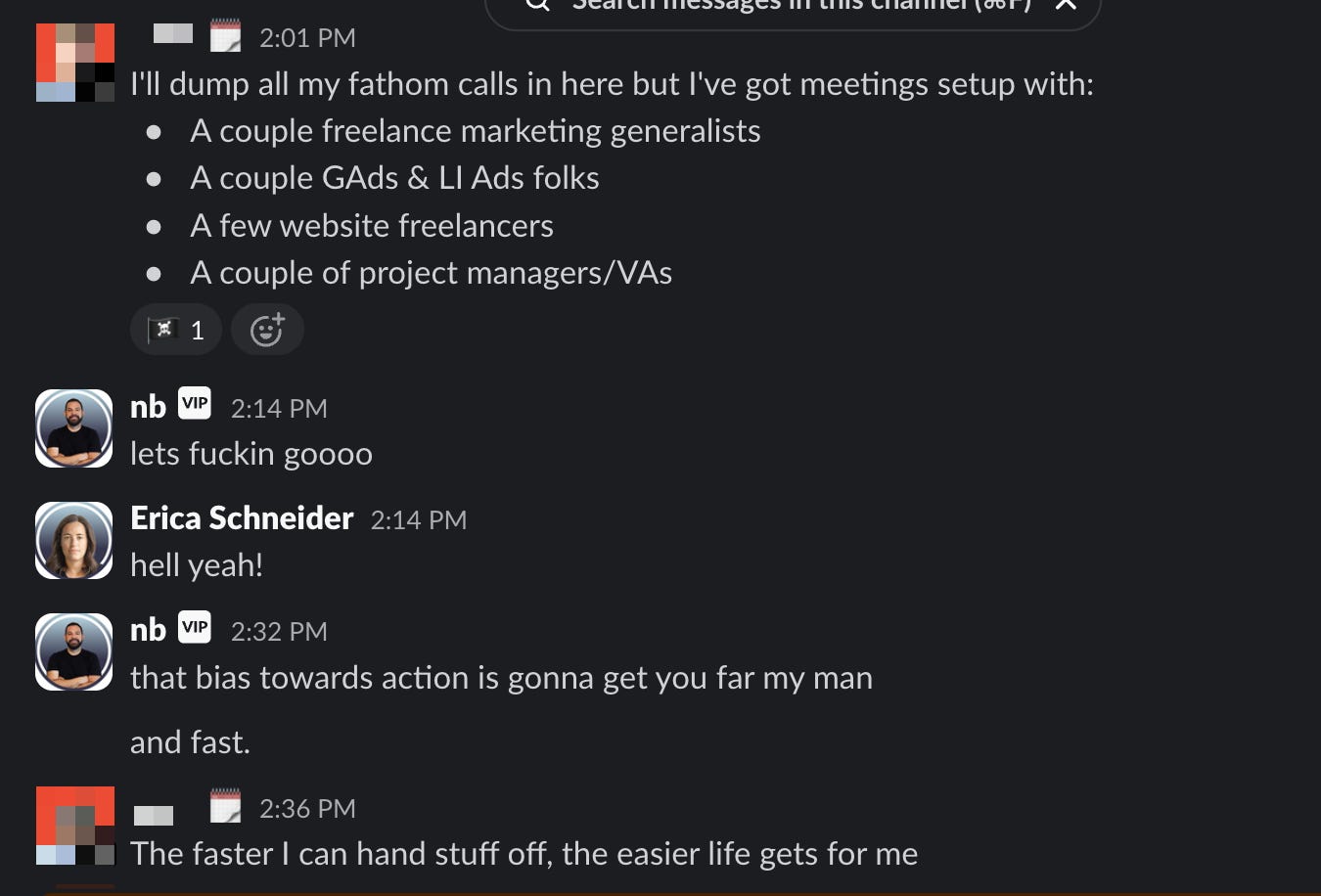
…2 days later…
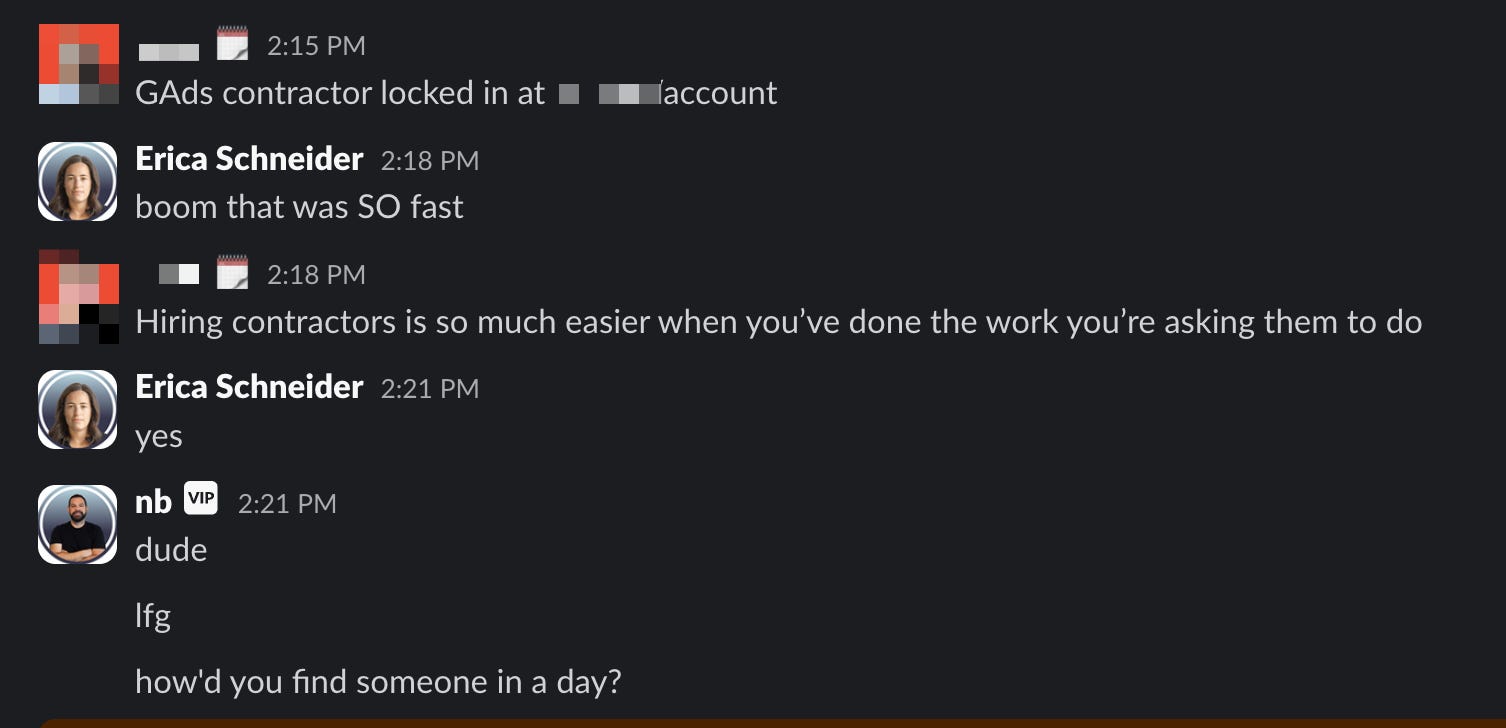
Within a month, his business went from $40K to $80K.
He finally had space to think strategically, instead of reactively. He could see opportunities he’d been too buried to notice. He could decide where to take the business, instead of responding to whatever showed up.
Most importantly, he stopped talking about going back to a job.
He consciously chose to run this business. He went from “I’m just doing stuff” to “I know what I’m building and why it matters.” That shift changed how he spent his time, who he hired, what he said yes to, and how he showed up for clients.
The business didn’t change overnight.
But within a month, a series of intentional decisions transformed him from a passenger into a driver.
Most people in Passenger mode feel busy and productive.
They get things done, clients are happy, and revenue is coming in.
That’s why the problem is subtler. It’s the feeling of being slightly unsure about every decision. The sense that you’re always reacting but never quite satisfied. The nagging question that pops into your head late at night: “Is this what I actually want?”
The worst part is you can’t answer it, because you never decided in the first place.
A client asked for something adjacent to your core offer, and you said yes because it made sense.
An opportunity showed up that could lead to more revenue, and you took it because why wouldn’t you?
You spotted a gap in the market that you were positioned to fill, so you filled it.
Every individual decision you made was smart in isolation. Taken together, they created a path you never consciously chose. This is what makes the Passenger Problem so hard to spot. You’re actually making good decisions—they’re just all responsive. You’re reacting quickly and intelligently to what’s in front of you, which is a genuine skill. It got you here.
The problem is that “here” is a place you never aimed for.
You confused motion with direction. The business is growing, clients are happy, and revenue is increasing, so it feels like you must be going somewhere intentional. But when you look up and ask, “Where am I headed?” the answer is uncomfortable: wherever the current takes you.
The fact that you’re busy, booked, and growing creates the illusion of intentionality.
The more successful you are, the more the Passenger Problem shifts from background noise to something you can’t ignore.
For most solopreneurs, it happens around $35–50K/month.
This is when the volume of your business starts to outpace the clarity that got you there. You have more clients, contractors, and moving pieces. Suddenly, every decision feels harder than it should.
You’re making good money, but you’re also:
Torn in half by every new opportunity (Should I take it? Is it a distraction?)
Unable to make fast, confident decisions because you have no destination
Watching your energy dip because you don’t know why you’re giving so much effort
This is also when solopreneurs start using words like “aimless,” “I don’t know,” or “hesitant” to describe how they feel. You’re making decisions every day, so you must be in control of where your business is going, right?
But there’s a difference between steering and driving.
Passengers are along for the ride, moving toward whatever the road presents.
Drivers first choose the destination, then intentionally select a route to get there.
The only difference is who’s making the decisions. Most of the time, you can’t tell until you stop to think and realize you have no idea where you’re going. By then, you’re already somewhere you never chose to be.
So, how do you transition from being a passenger to being a driver?

How to Become the Driver of Your Business
The shift from passenger to driver isn’t tactical.
Most people think they need a detailed five-year plan or a perfect roadmap before they can take control. But driving your business means making decisions from a chosen destination instead of letting whatever pops up dictate your direction.
Here’s what that looks like in practice.
1. Decide what you want from your business.
A lot of people start with the wrong question: “What revenue do I want to hit?”
Revenue is a result, not a destination. Hitting $100K months doesn’t tell you anything about whether you’re building something you want long-term.
Take another client who hit seven figures last year, which is a massive success by any measure. But his revenue was lumpy. Some months were great, some less great. He was working 40-50 hours a week, constantly kicking admin tasks down the road because he was too busy doing client work.
When we asked what he wanted, he said: “I want a more predictable and durable business. I want to take a break from the employee-employer relationship.”
He didn’t need more revenue. He needed his life back. And until he could name that, he had no way to build toward it.
The underlying question is: What does this business make possible for my life?
The answer is different for everyone.
“I don’t need more money. I want to work three hours a day instead of eight.”
“I want to cap at $40K/month and keep my life simple because I have a six-month-old, and I’m happy.”
“I want to double revenue so I can get completely out of the work and focus on the thing I’m passionate about.”
“I want to build this business into something I can sell and exit in five years.”
None of these answers is “better” than the others. What matters is that you decide what you want.
Figuring this out isn’t always straightforward. Most of our clients have never been asked these questions before, which is why we have every client take what we call a Freedom Assessment. It forces you to look at your business, often for the first time, and answer hard questions about what you’re building and why.
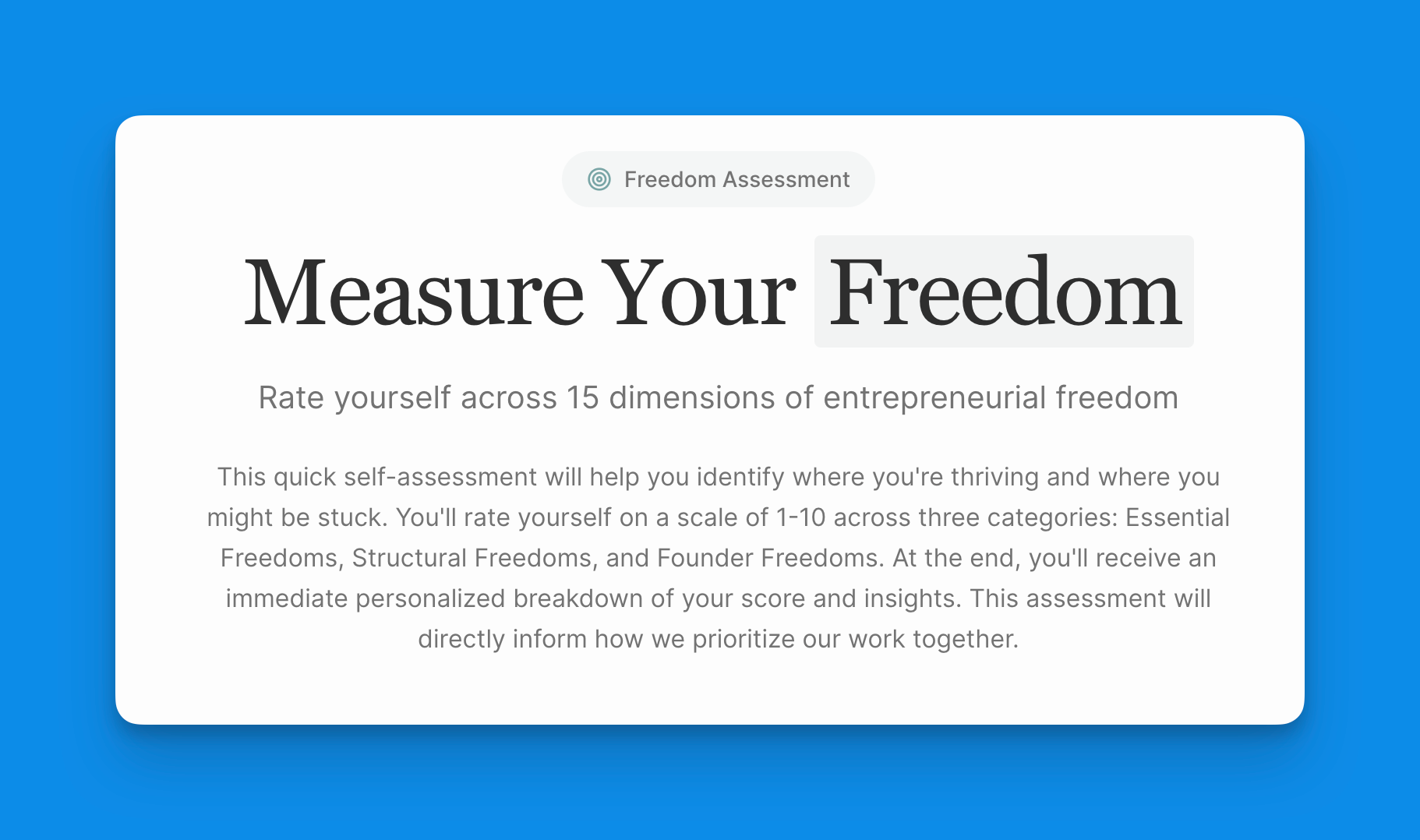
It reveals the gap between what you’re doing and what you want.
Once you see where you want to go and make a decision, every other decision becomes easier. The answer doesn’t have to be perfect—it just has to be yours.
2. Notice what’s giving you energy and what’s taking it.
In our audit process, we ask clients: “Is this giving you energy or is it taking energy?”
If something is draining your energy, we start there. Why are you doing this? Who else could be doing this? How do we automate or delegate it?
Take another client, Brian. A year ago, he was doing $25K months, running entirely on referrals with zero inbound leads. He was stuck in delivery mode because he was great at the work. But he was constantly busy and terrified that referrals could dry up at any moment.
He had no time for business development or energy for marketing.
He spent all his hours executing on client work instead of building the infrastructure to scale.
So, we helped him gain recognition for a specific problem he solves and rebuilt his content around it. Within months, 70% of his leads started coming from LinkedIn. His business went from $25K to $150K/month.
But the true transformation was his energy.
To handle the influx, Brian hired three senior contractors, standardized his engagement model, and stopped doing all the delivery work himself. He freed himself up to focus on work that moved the business forward: strategy, business development, and marketing. Now, his contractors are building their own LinkedIn presence, and the business is compounding without Brian being the single point of everything.
Here’s how to audit your energy:
Spend a week paying attention: What tasks drain you? Which tasks give you energy? Where are you spending your time?
Then ask: If this is taking my energy, why am I still doing it? Who else could do this? How do we automate or delegate it?
Sometimes you’ll find you’ve already delegated the energy-draining work to the wrong people, leaving you carrying it. That’s what happened with one of our clients. He had contractors, but they weren’t doing the work well enough. So he was still doing tasks that drained him most.
The audit reveals where your energy is going, not where you think it’s going.
3. Decide when enough is enough.
When you define “enough,” almost all of your decision fatigue disappears.
You know what to say yes to and what to pass on. Consider one of our clients who was doing $35K per month but was stressed and constantly comparing herself to her friends. She has a toddler and an infant, unstable daycare, and no bandwidth to scale the way others in her network were scaling.
She looked at her life and said, “This is my number. I’m capping here for now.”
That doesn’t mean forever, and it’s not a ceiling she’ll never break through. But for this stage of life—with two young kids and limited capacity—$35K per month is enough.
The clarity changed her business. She brought on her first VA to handle the tasks that kept her from spending time with her kids. The second she stopped trying to keep up with everyone else’s version of success, her business exploded. Leads started coming in. She got to choose who she worked with, and she raised her prices twice.
The decision was: “I’m done growing in ways that don’t serve my life right now.”
The question underneath this is:
Do you want to stay where you are, or do you want more?
Neither answer is wrong. But building toward $80K requires different decisions than optimizing to stay at $35K. You have to choose one, because trying to do both at once keeps you stuck in passenger mode, reacting to whatever comes next instead of directing where you’re going.
Too many people avoid this question because once you answer it, you have to evaluate your relationship with the “success” treadmill.
But the cost is spending years building toward a destination you never chose.
4. Stop doing the button-clicking work.
As a business owner, your job is business development, marketing, strategy, and client relationships.
Everything else (low-value tasks, admin work, and tactical execution) should be handled by someone else for the first version. You can (and should) still review. You just shouldn’t be the one building it from scratch.
This is where most people resist. They think: “But I’m good at this. I’m fast at it. Training someone else would take longer than just doing it myself.”
That’s Passenger thinking.
The work that built your business early on becomes the ceiling that keeps you stuck. To audit your button-clicking, look at everything you did last week.
What could someone else have done?
What’s taking your energy that doesn’t require your specific expertise?
That’s what you delegate first because it keeps you in Passenger mode instead of Driver mode.
Getting in the Driver’s seat means you set a destination, even a rough one, and every decision you make gets you one degree closer to it.
Do you want to be the person who runs this business, or the person who owns it?
Running the business means you’re in it every day, doing the work, talking to every client, tapping the keyboard to create deliverables. Owning the business means you’ve designed it to work without requiring all of you, all the time.
Neither answer is right nor wrong.
Most solopreneurs have never consciously chosen one. They just defaulted to running their business because that’s what worked early on.
Actively choosing to drive your business changes:
How you spend your time
How you make decisions
How you show up for clients
How you structure your days
What you say yes and no to
The tension lifts, apathy goes away, and the people around you can feel it.
Your business can take you anywhere, but only if you decide where you want to go.
So where, exactly, is that?
Most solopreneurs who get into the driver’s seat discover that having a destination isn’t enough. You also need to know how you’re going to get there—and that means making intentional decisions about how your business runs. Not just what you do, but how you market it, how you sell it, how you deliver it, and how you structure it to grow without consuming you.
That’s what we’re covering next.
Cheers,
Nick, Erica, & Katrina
P.S. – Ready to standardize your custom consulting services? Book a call with Nick and Erica.
P.P.S – Want to share your unique POV with mini-books like this one? Book a call with Katrina.
Have questions? Ask us in a comment below.
Nick & Erica - this was a really helpful and appreciated read. While I’m trying to get going from a standing start personally, I realized I was the passenger in my b2b career for 20 years and that’s why I burned out the way I did. So, fwiw there are multiple applications to the concept:)
Great exercise for everyone if if they earn much lower or higher than these numbers. It's crazy how you can carry the same thinking patterns even at scale.