




Welcome to How Solos Scale. Each month, we share a new framework, concept, or example of how solopreneurs & micro agencies are scaling from $30,000 to $100,000+ per month.
Hi there,
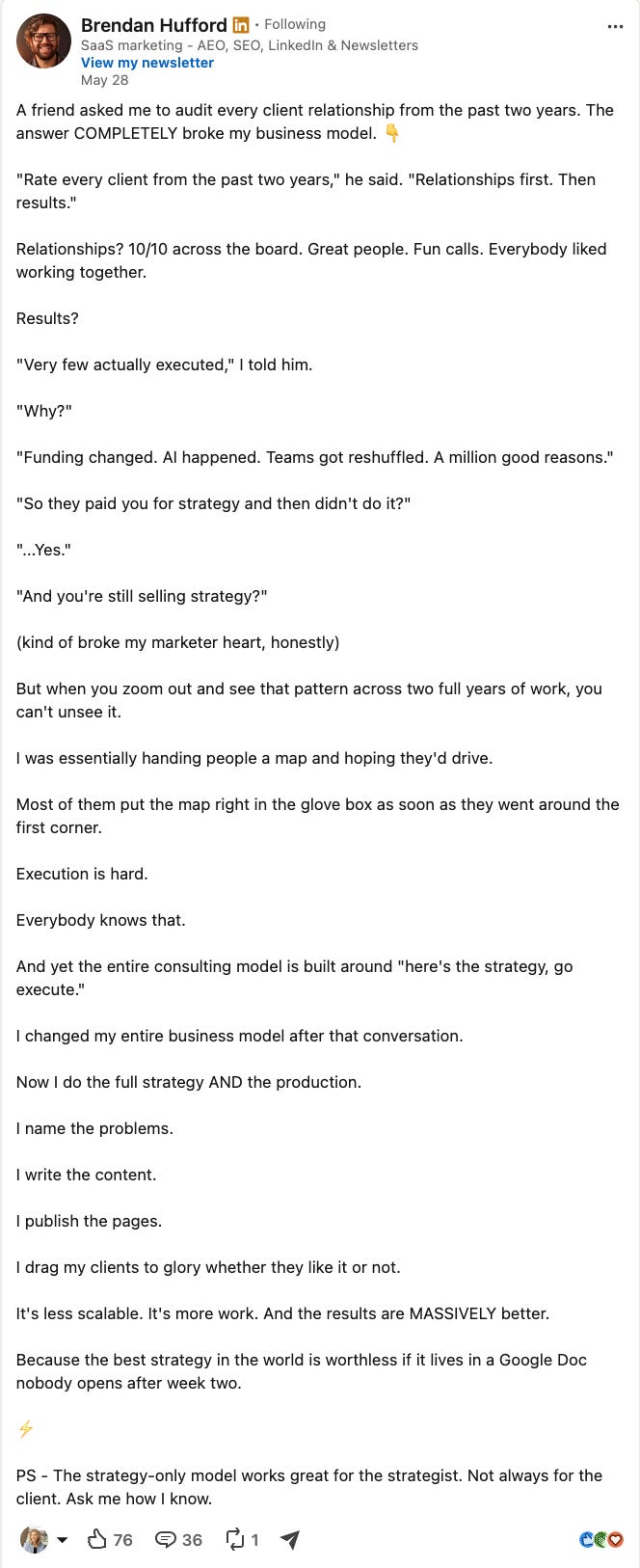
In late 2025, Brendan Hufford realized something about his client results that changed his entire business model.
Brendan sells content marketing strategy to SaaS companies that want to grow to $100M ARR. He’s built a strong reputation in that world, and his business does well. By any outside measure, he’s crushing it.
But the way his work played out didn’t sit right with him.
He’d build a strategy, hand it over, and tell clients exactly how to execute it. Most of them still didn’t. For the few who did, the work often fell flat, leaving Brendan with a client who had nothing to show for it.
When Brendan started working with us, we ran an audit.
We asked him to look back at every client he’d worked with over the past two years and rate each one on two things: 1) the relationship, and 2) the results.
Brendan’s relationships were great across the board. He liked his clients, the calls ran smoothly, and everyone enjoyed working together. The results told a different story. Very few clients had executed the strategy he’d delivered.
Once he saw this pattern stretched across two full years of work, he couldn’t unsee it.
As he put it, “I was essentially handing people a map and hoping they’d drive.”
That’s a hard thing to admit when you’re good at what you do and well paid for it. It sucked that his clients weren’t doing anything with the strategies. He didn’t want to keep building a business that way.
So, he changed how he works with clients.
Instead of handing over the plan and walking away, Brendan now does the strategy and the production. He names the problems, writes the content, and publishes the work himself. The results are, unsurprisingly, massively better.
Today, Brendan drags his clients to glory—whether they like it or not.
Sound familiar?
Maybe you’ve delivered a strategy that could change your client’s business for the better and watched it go nowhere. Maybe a client has sat on your advice for three months. Maybe you’ve asked yourself, “What’s all this for?!” and didn’t love the answer.
If so, we got you. We hear this story from client after client. Often, the fix isn’t a new framework, offer, or niche. It’s accepting a different idea of your job and doing what it takes to get results.
In this mini-book, we’ll cover:
What it means to drag your clients to glory, and why their success lives and dies with you
Why selling strategy alone stalls your business, and what it costs you
How to know whether your work makes a difference for clients
Why solopreneurs resist execution, and why doing the work makes you more valuable
Three ways to drag your clients to glory in your own business, and what changes once your clients see results
Let’s get into it.
What it means to drag your clients to glory
Years ago, when Nick worked in business development for a marketing firm, he worked a deal with a sales guy. They got to talking about clients who just don’t want to win. Some clients nod along, accept the plan, and never do anything with it.
The sales guy shrugged. “You can’t drag everyone to glory.”
It was an offhand comment that he probably forgot by lunch. But it stuck with Nick. Years later, after starting his own business and helping hundreds of clients, Nick landed on the opposite conclusion. Dragging clients to glory is the job.
Anyone can tell a client what to do, but few can help them do it.
Dragging your clients to glory means doing what it takes to make them successful.
You might have to extend your engagement for three months to help a client implement your strategy. You might have to stage and schedule newsletters so they’re not responsible for publishing. You might have to join a client’s sales call and help run it, so they can see how it’s done.
“Getting” this mindset is different from “doing” something about it. We hear a lot of excuses:
“I gave them the strategy, and they picked it apart.”
“I wrote the posts, and they never published them.”
“It’s not my fault they never approve anything.”
These might all be true, but none of them lead to a win. And when the wins don’t come, resentment builds. You pour hours into a plan, a draft, or a campaign, only to watch it sit there unexecuted. It’s annoying at first. But by the tenth time, you feel a little dread and frustration before every handoff.
When that happens, you tend to slow down client work. You lose the spark for running your own business. You start to wonder if what you do matters.
We call this the passenger problem. It wears you down and leads to burnout.

Burnout comes from doing a lot of work that amounts to nothing.
We see it all the time. A solopreneur builds a business that looks great from the outside, then wakes up one day and wonders whether it’s worth continuing. At that point, they either give up and go back to a 9-to-5 job, or they drag their clients to glory.
That might sound harsh. But as a business owner, you’re responsible for results. This is especially true when the same excuses keep coming up and every client stalls at the same point.
If your clients aren’t doing what you advised them to do, that’s your problem to solve.
Even a bad-fit client is on you. Maybe you signed them when you knew you shouldn’t have, or you kept them on longer than you should have. Either way, the outcome traces back to a decision you made.
Repeated problems signal a pattern.
The awesome thing is, once you see it, you can find the root cause. We’ll show you how later on.
To be clear, we’re not anti-strategy. Strategy is important, and you should keep doing it.
The problem is strategy alone.
Why strategy alone stalls your business
Think about why clients hire you. They don’t have the time, the team, or the know-how to do it themselves. And even when they do, something gets in the way.
The person who owns the work leaves. A rebrand or a site refresh pushes the plan to the bottom of the pile. The internal writer reports to someone else, and you have no say over their priorities. As Brendan told us, “I’m not their boss. I can’t make them do it.”
He’s right. You can’t control anything unless you take back the wheel.
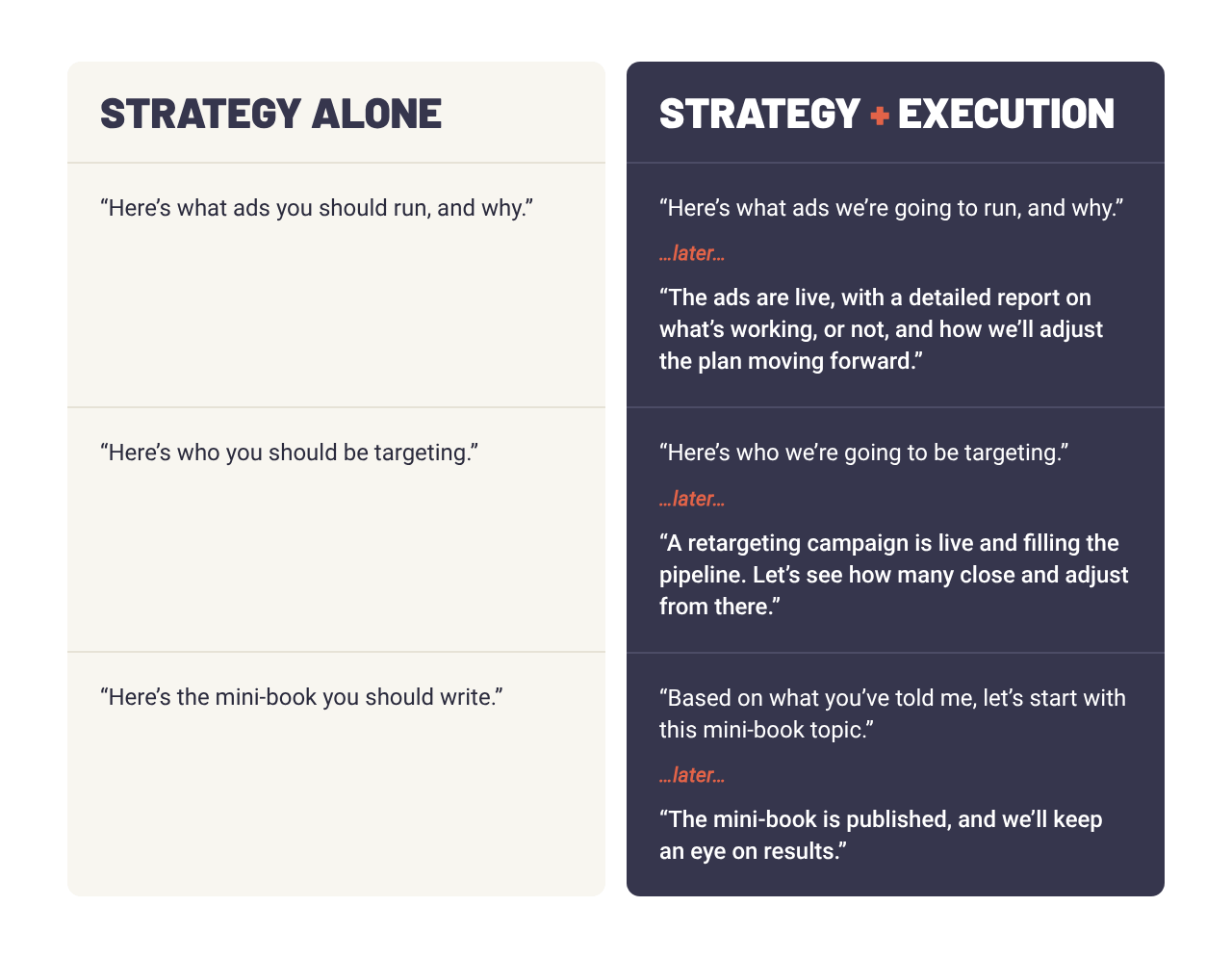
Brendan said it best after his audit. The strategy-only model doesn’t always work best for the client. That was a hard pill to swallow, but it revived his business.
Of course, you can build a decent business on strategy alone, but it comes at a cost.
Limited proof. Ask a strategy-only consultant what outcomes they’ve helped clients achieve, and you’ll often hear, “Well, they never implemented it.” Or, they did implement it, but they made so many changes (for the worse) that you don’t even want to be associated with it.
Limited testimonials. Every client who doesn’t get results is a testimonial you never get. That’s a huge bummer.
A dent in your reputation. When the work sits untouched or gets done badly, it still reflects on you. (AKA even if you don’t want to be associated with it, sometimes you can’t run from it.)
A ceiling on price and LTV. Without results, it’s hard to charge more and increase lifetime value.
Constant churn. When the engagement ends at the strategy, so does the relationship (hence the low LTV).
This hits harder when you run your business solo or with a small team. It’s hard to feel good about your work when you can’t point to what it changed, and you have no one to even talk to about it.
This is usually when an existential crisis takes hold, a la:
“What am I even doing with my life?!”
How do you know your work matters?
If your clients aren’t getting results, it’s worth asking a hard question:
Is your work making a difference for your clients?
Take one of our clients, a LinkedIn ghostwriter, as an example. He was sending DMs on his clients’ behalf and getting a 30% response rate, which is about as good as cold outreach gets. But when Nick asked how many of those replies turned into business, the answer was almost none.
The response rate looked impressive on paper, but it didn’t make his clients any money.
The hardest conversation we have with clients is when they realize their work isn’t making the difference they know it could.

This happened to one of our marketing clients, too. When we ran her audit and asked about outcomes, she gave a different reason for each client’s lack of results. One didn’t implement. Another never published. Another wouldn’t listen to anything she said. She had plenty of excuses, but no wins.
So, we asked: “What do you do that matters?”
She couldn’t give an answer.
Her story is more common than you’d think. Your work might feel busy and important, but if it doesn’t make a difference for clients, no amount of effort will fix that. The only solution is to find work that moves the needle and see it through. For a lot of solopreneurs, that means getting back into the weeds. And that’s where many people push back.
Why smart solopreneurs resist execution
If you spent years as a director or VP, you set the direction and someone else did the work.
When you start your own business, it’s natural to keep playing in that same space. Stepping back into execution can feel like a step down. You worry that writing the posts or joining the sales calls means you’re no longer the premium asset.
We’d argue the opposite. As a business owner, your track record is all you have.
If every client works with you and walks away with nothing to show for it, your premium positioning doesn’t count for much. Results make you more premium. That doesn’t mean you have to do every piece of work yourself. You can hire a team or bring in a specialist. But someone has to do it for your clients. If you’re standing in the way of results, it’s time to get over yourself.
Disclaimer: Just because you can do things doesn’t mean you should. That’s how we end up with custom scopes and scope creep. Step in where the wheels fall off and stay disciplined about the rest. Anything outside that, refer out or add to your offer on purpose.
By the way, if you want to hear us rant about this, listen to our strategy vs. execution podcast episode. We go deep.
Can’t AI do the execution?
Let’s be honest: AI can handle a lot of the execution. We said as much in our Vantage Point mini-book. It can draft the posts, write the ad variations, and build the briefs, and it gets better every day.
But having the tools doesn’t mean your clients will use them, or use them well.
That’s because AI can’t decide which work matters for this client right now, notice when the work isn’t landing, or know what to change. That judgment lives at the beginning and end of every deliverable.
When you own the execution too, you get the whole loop: you decide what to do, get it done (with AI or without it), and assess whether it worked. That loop gets clients results, and it makes you hard to replace.
Anyone or anything capable of executing can execute. The value is in getting the work done at a level that produces results, regardless of who does it or how.
So, let’s talk about how to do that.
How to drag your clients to glory
We learned this the hard way.
Nick used to coach clients on offer strategy and positioning, then help them think through their LinkedIn content. The strategy landed, and clients understood it. But they hit the same wall every time: “This makes sense, but I don’t have time to write. And my writing sucks.”
The strategy was solid, but the posts never went out.
Without the posts, the strategy couldn’t reach the market. Nick had found where the wheels fell off. His clients wouldn’t write the content, even though it was the linchpin of their success.
Erica hit the same wall from the other direction.
As a writing coach, she’d interview clients to pull out content ideas. But the more questions she asked, the more holes she found in their business model. Clients would end up admitting they weren’t sure their business even made sense.
All she could say was, “Sounds like you need a business coach.”
She could help them write great content, but great content can only carry a business so far. Content won’t matter if the offer, the delivery, or the business itself doesn’t back it up. But when the rest of the business works, content can become the deciding factor that sets a company apart.
Nick needed Erica, and Erica needed Nick.
We realized offer design and marketing have to go hand in hand because positioning, messaging, and content only make a difference when the business underneath them works. So, we merged our businesses to drag our clients to glory.
Now, our clients get the offer strategy and business coaching, plus LinkedIn posts written for them. We watch for signals to see what’s working, double down, and get results.
Your “drag to glory” work will look different from ours, but you can approach it a few ways.

Example 1: Find where the wheels fall off.
Every client engagement has a point where progress stalls. That’s where you start.
One of our clients, a messaging consultant, saw it happen with a SaaS company he’d worked with. He built them a new storyline, and their CEO started posting about it on LinkedIn. But their homepage never changed. The company didn’t know how to turn the new story into the assets the market would see, so the work stopped at the handoff. “It doesn’t manifest itself externally,” he told us.
With his next client, he didn’t stop at the handoff. He rewrote their homepage himself, then started working through the rest of their assets so the new story showed up everywhere buyers looked.
Look back at your last few clients. Where did the work stop moving? You’ll probably see the same spot come up again and again.
The client signs off on the new messaging, then never updates their website. Or they update it and change it again two weeks later.
The client gets a clear plan for which ads to run, and the campaigns never launch.
The client has a great meeting agenda but can’t run the meeting the way it needs to go.
That sticking point is your opening. It shows you right where your clients need you to step in. Over time, as long as each fix makes a difference, your offer will shape itself around what your clients need to win.
Example 2: Get in the room where results happen.
One of our clients, a sales training firm, gives founders a strong agenda for their sales meetings. But the founders didn’t always run those meetings according to the agenda. As a result, the calls flopped and didn’t lead to more sales.
Our advice: join the meeting, run it with them, and show them how it’s done.
If you’re a sales training firm that never sees your clients sell, how can you help them improve?
We review clients’ sales calls at Duo, and it makes a major difference. Most business coaches never look at these calls. We do, because that’s where the offer and positioning happen.
Example 3: Pull out all the stops.
When a client is close to a win, don’t wait for them to cross the line on their own.
Do what it takes to get them there, whether that means rewriting a landing page, running the first campaign, or sitting in on the meeting. One solid win is worth more than a dozen smart plans. It gives you a story to tell, a testimonial to share, and proof that your approach works.
Sometimes dragging your clients to glory means dragging them over the finish line.
This was true for Katrina, who had to rework how she delivered mini-books. She noticed clients struggled to review the drafts, which led to missed publishing deadlines. Missed deadlines meant inconsistent publishing, or not publishing at all. To drag clients to glory, Katrina now immediately schedules a review call if someone misses a deadline. The mini-books get published on time, and her clients see the impact of consistently sharing their point of view.
Pull out all the stops to finish what you started.
Dragging clients to glory starts by deciding what you want
People often ask us how hard it is to get results.
Do I need an entirely new process? A massive team?
No. You just have to decide what kind of business you want to run. You can keep handing over plans and hoping clients follow through, or you can build a business where clients win because you made sure they did.
Once you decide, the rest follows. You find where the wheels fall off. You step in. You build the small team or process to get outcomes.
When your clients get results, you finally feel good about the work again. What a relief! The dread before client calls fades. You get the proof, testimonials, and track record that bring in more clients and let you charge what you’re worth. These consistent outcomes keep you in the game.
And if your clients are crushing it and you still feel restless?
That’s a good problem to have. Usually, it means the goalpost has moved. Your clients are winning, so it’s time to decide what’s next for you.
But first, you have to decide.
Do you hand over work and hope for results? Or do you drag your clients to glory?
Cheers,
Nick, Erica, & Katrina
P.S. – Ready to speed up the transition from consultant to micro agency? Book a call with Nick and Erica.
P.P.S – Want to share your unique POV with mini-books like this one? Book a call with Katrina.
Have questions? Ask us in a comment below.
And then of course make sure you choose to serve a client that can afford to pay your rates for the service as you drag them to glory, as yall do. Loved our convo about this last year!
INCREDIBLE writeup - hope this helps more people!