



Welcome to How Solos Scale. Each week, we share a new framework, concept, or example of how solopreneurs & micro agencies are scaling from $30,000 to $100,000+ per month.
Hey there,
One of our clients in the demand gen space was having a great week.
He was mid-conversation about raising his retainer with one of his anchor clients, a B2B SaaS company he’d been running paid media for over two years. The relationship was strong. The results were legit. The timing felt right.
Then, he got a text from his client.
The company’s head of growth wanted to know whether they could build something in Claude Code to handle 90% of his work.
Our client didn’t see the text and spiral. He let his team know about it and said, “This isn’t a threat if we handle it correctly, but it’s a forcing function. We need to get sharper on a few things.”
That’s the right response.
When asked about AI, most consultants say, “Trust me, AI can’t do what we do.” Or worse, “We use AI constantly. We’re not behind on this.”
These replies don’t work because no one cares how you’ve integrated AI into your work or what percentage of your process runs on it. They care about whether the service they’re paying you $10K, $15K, or $20K a month for is worth it, or whether they can build a passable version of it for a $200/year AI subscription.
Almost every B2B services consultant will face some version of this conversation.
It’s going to come up more often as AI tools improve and the people inside your clients’ businesses get more comfortable using them (or scared of what happens if they don’t hop aboard the AI train).
When it does, the answer can’t be “Trust me, bro.”
It has to be rooted in something more durable, aka the judgment, intuition, and cross-portfolio pattern recognition that comes from years of doing this work across dozens of clients.
At Duo, we coach clients through this every week. Our POV:
AI can: Generate options, deliverables, even strategy.
But AI cannot: Tell you which one is right for this client, at this moment, given everything you know about their business and their market.
That’s a human problem. It needs someone who has seen the situation play out enough times to know which way it typically goes, and who can hold a point of view under pressure without flinching.
That’s your Vantage Point, and it’s the most defensible thing you have.
A Vantage Point is the elevated view you get from working across many clients simultaneously.
It’s the patterns, signals, and judgment that no client, and no AI tool, can replicate from the inside. It’s built from every client, campaign, and hard call you’ve made throughout your career.
To demonstrate this, imagine you’re a pilot sitting in a cockpit, flying 10,000 feet above the ground.
You’re approaching an airport to land, but your field of view is narrow. It’s tough to see the planes above you, below you, or on either side. And when flying through the clouds, you rely solely on instruments.
Now, imagine you’re an air traffic controller looking at a radar of the area. You see dozens of planes at varying altitudes, and your goal is to prevent potential conflicts. You’re not a pilot, but you have a more effective view than the pilots. Communicating and controlling is your job.
Pilots know how to fly a plane, but controllers direct traffic because they see all the planes.
If you have 5, 10, or 15 clients, you’re the air traffic controller. Your clients are the pilots, focused on flying their own planes. (They’re aware of the other planes, of course, but they don’t have a direct line to their comms and flight plan.)
The best consultants do both roles.
Sometimes you’re purely the controller, watching the radar and guiding your client as they fly.
But sometimes you climb into the cockpit yourself. You take the controls, execute the work, and run the play.
The difference is that you never give up the controller’s seat to do it. You fly and watch the entire airfield’s radar, while communicating with everyone, so you know and see everything, which is basically a superpower.
This structural difference (superpower) is what makes your Vantage Point irreplaceable.

Understanding that you have a Vantage Point changes what you charge, how you talk about what you do, and how you handle the moments when clients start asking hard questions.
It’s also, if we’re being honest, the reason consultants get hired instead of full-time employees. (Among other reasons, like the fact that consultants carry far less risk, far less handholding, and far fewer political barriers than full-time hires. But we digress.)
Consultants have always been valued, but they haven’t been scrutinized at this level before.
AI has changed the game. So let’s change our response.
The 3 components that make your Vantage Point irreplaceable
“Vantage Point” can sound abstract until you break it into parts.
When we workshop this with clients, we look for three specific things in their work.
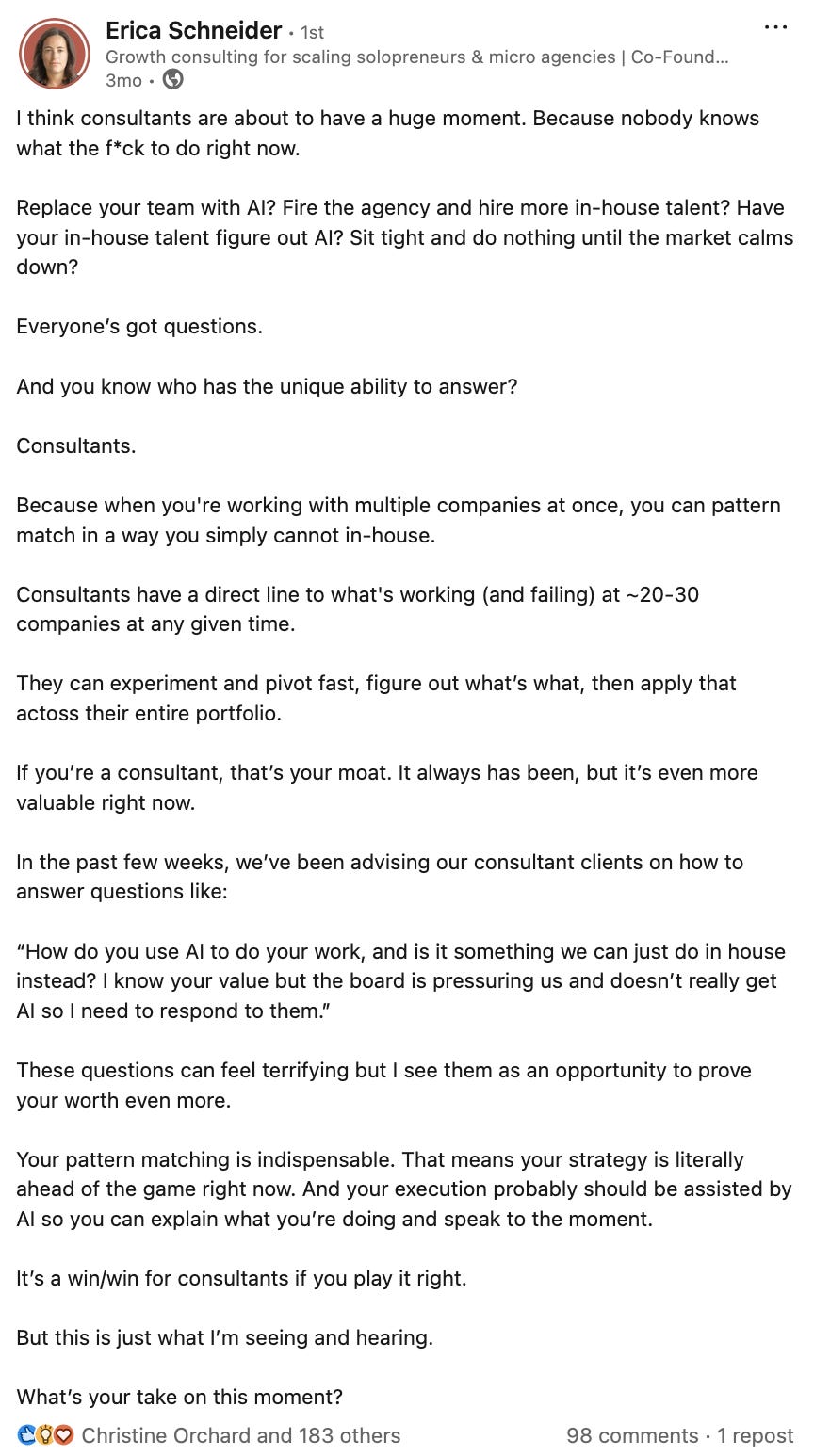
1. Pattern matching across a portfolio
Our demand gen client mentioned at the start manages over 30 accounts simultaneously. That’s millions of data points, across different verticals, budget levels, and funnel stages, all feeding his read on what’s working and what isn’t.
His client’s in-house team manages one account.
Even if his client gave an AI tool every piece of historical data they had, it would be pattern-matching against itself, not against 30 comparable companies running similar motions at the same time. You can’t prompt your way to that data dashboard. You’d need to manage 30 accounts to build it.
Another client of ours, a fractional growth operator, put it this way: Clients only know their own business.
They live inside their company, so when something goes wrong, it feels new and confusing to them. Nobody’s ever dealt with this before.
He, on the other hand, has worked across hundreds of companies. So when a client walks in with a problem, he’s already seen that problem play out somewhere else, maybe more than once. It doesn’t matter who shows up or what they think is unique about their situation, because he’s matching it against everything he’s already seen.
He proved it with a $3,000 Reddit campaign.
A nonprofit coding organization hired him to audit its entire growth system. He recommended Reddit. They were skeptical because Reddit wasn’t on anyone’s roadmap. But he’d run that exact campaign four times before at other companies. He knew engineers hung out on Reddit.
The campaign generated 1,200 signups at $3 per application, which was the best result the organization had ever seen from any channel.
Claude Code didn’t suggest Reddit. It couldn’t have. That recommendation came from pattern matching across his entire client portfolio. There are very few demand gen firms with the Vantage Point into niche vertical B2B SaaS paid media at the volume and scale our client has. That’s just a fact.
If you’ve worked with dozens of clients, you have similar pattern-matching capabilities.
2. Judgment in the gaps
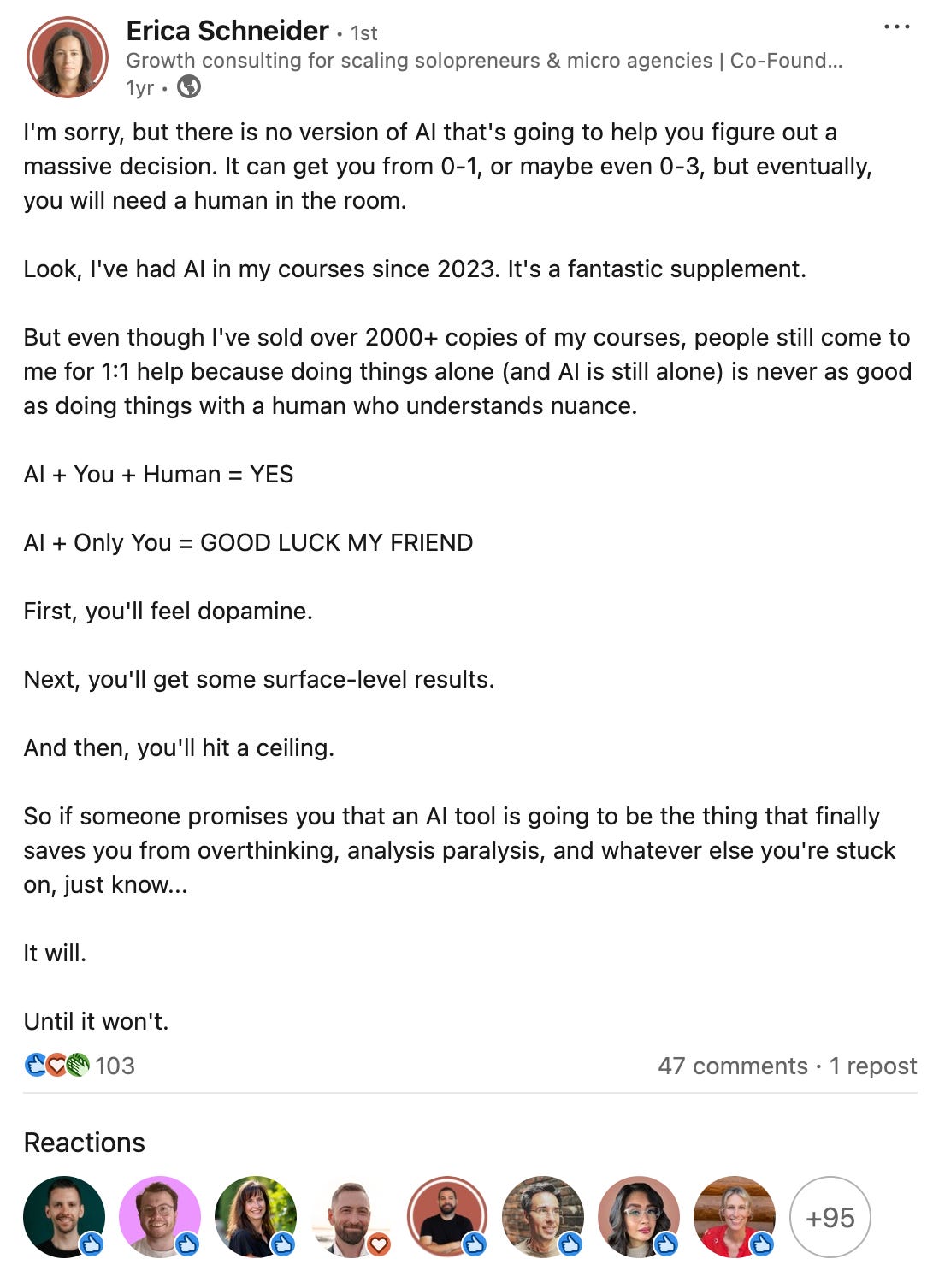
The second component is the work AI can watch but can’t do.
One of our clients explained it this way:
“I’m not hiring you both to do the work. I’m hiring you to tell me what work to do and to hold me accountable while I do it.”
It’s indisputable that with today’s AI tools, certain deliverables are on the chopping block. Most consultants use AI to produce them faster, and that’s fine.
But what happens before and after the deliverables is a different story.
Before handing off a deliverable, the best consultants look inside the business, figure out what’s going on, spot the patterns the client can’t see because they’re too close, and make the hard call when two options both look right.
After a deliverable, they run a post-mortem, assess what worked and why, and adjust.
This is where your judgment, built from years of seeing situations play out across dozens of clients, enters the chat.
Here’s an example of how this played out with another client of ours:
Brad is a fractional operations consultant, and he had a client who was keen to hire someone full-time to fix a problem. He stopped them.
Instead, he scoped the workload and immediately realized a full-time hire would have meant overpaying for capacity they didn’t need yet. He told them they only needed someone part-time, maybe two days a week max.
He also had a contractor in his network with the exact clinical background, and handed the client her CV on the spot.
An AI tool could have told them “consider a contractor” as a generic option. It couldn’t have known the real hours required, or had the specific person already lined up to get the job done.
Go Brad. His response was pretty badass tbh.
3. Context decay
The most valuable part of a Vantage Point isn’t what you know today.
It’s that you’re continuously refreshing what you know every day.
Each new client, test, or campaign that fails or flies across the portfolio updates the signal in real time. An in-house team could theoretically train an AI on everything you’ve created for them. But that knowledge would begin to decay immediately, and they’d have no mechanism to keep it up to date.
Picture a business that publishes regularly, using the same AI tool to write every piece. Six months ago, their content might’ve felt sharp, specific, even spot on.
But today? The same tools and process produce something that reads like a shadow of itself. The ideas are still there, but readers can feel it’s gotten… meh. You can tell there’s a robot behind the teleprompter.
This is what happens when you let that expert copywriting consultant go. “AI can take over, we’re all good!”
Well, guess what the copywriter took with them?
Fresh context and judgment.
Context decay is a maintenance problem that’s invisible until it’s missing.

This is why the work itself is what keeps a Vantage Point alive.
Think about how AI optimization tools built directly into ad platforms, like LinkedIn’s native Performance Max optimization, have been trying to do what consultants have done for years. It has access to platform-level data at a scale no consultant could match. And it consistently blows budget on bad decisions, because it doesn’t have the judgment to know what good looks like in context. It’s always current, and it’s still wrong.
Being current isn’t enough. You need current plus calibration. And that only comes from seeing enough situations play out to know which signals matter.
Understand your value, then articulate your Vantage Point.
Before we go further, let’s clarify a common misconception: Adding value and creating value are not the same thing.
Most consultants love to “add value” because they don’t know what else to do.
Adding value looks like a swipe file. It’s a list of templates, a deck of best practices, or a Google Doc of high-performing post formats. It saves a client time, but it’s also something they could find anywhere. It’s not the reason they hired you.
Creating value looks different. It’s knowing which template to use for which client, in which moment, because of a problem only you can see. Say the client’s posts aren’t generating pipeline. Here, a hook template won’t save you. To create value, you have to understand why the content isn’t working, and advise how to overcome it (e.g., post more proof!)
AI is very good at adding value. It can produce all the swipe files, templates, or checklists in the world. Instantly and for free. We’re all swimming in artifacts.
But it can’t know which one matters for this client, right now. That judgment call creates value, and it’s why you get hired as a consultant instead of being sent a folder of “new employee onboarding” resources.
If your offer is mostly value-add, AI is a threat.
If your offer is built on creating value, AI can’t touch you, because creating value requires the Vantage Point you’ve already built.
You don’t just do the work. You decide what to do, do it, and assess whether it worked. That full strategy-plus-execution loop makes you hard to replace. AI can’t replicate the judgment that lives at the beginning and end of every deliverable.
So instead of wondering: “How do I justify my value?”
Ask: “Does my offer create value?”
If the answer is yes, you have to articulate why. This is where a ton of solopreneurs get stuck. They have a defensible Vantage Point, but they’ve never had to put it into words. The AI question is new. So you have to create a new answer.
Our demand gen client didn’t have a polished answer ready when asked whether he could be replaced with AI. But he had time to think. He brought the question to us, and we helped him think it through with a few questions:
How do you create value for your clients?
What difference does it make for them?
Is it vulnerable to AI?
We workshopped it and designed a clear-eyed breakdown of what his team does that AI genuinely can’t replicate.
One is cross-system judgment. When campaigns perform poorly, his team digs into historical data, identifies competitors with high lead quality, and turns that into optimization opportunities. An automated AI system would have paused “poor-performing” campaigns.
Another is cross-portfolio intelligence. Every account they manage benefits from what they’re learning across every other account. They know how Demand Gen is performing for B2B SaaS right now. What’s working, what’s breaking, and what happens when certain thresholds aren’t met. That insight reaches his client’s account immediately, not six months later when annual reports are published.
When communicating your Vantage Point to a client, lead with this framing: “You’re not paying for the 90%.” You’re paying for the 10%.
Your 10% goes way beyond which buttons to push. It’s about understanding how your industry’s machine works and what it’s supposed to produce.
Our client’s 10% is knowing which of 30 campaigns to double down on, and why. It’s recognizing whether a CPL is signal or noise, given what you’re seeing across comparable accounts right now. It’s knowing when a new platform feature is worth testing immediately versus when to let it marinate. It’s the call he makes when a client says, “This just happened. What do we do?”
To be honest, an AI tool could probably replicate a lot of what his team does.
AI handles surface-level execution well (ad copy variations, keyword lists, headline testing, search term reports), and it’s getting better every day. Conceding that point is honest, and his client respected it. But the true scope of his work is Google, LinkedIn, HubSpot, and full-funnel reporting tied back to closed-won revenue.
After our client explained his Vantage Point through the 10% lens, he closed a $13k/month retainer.
Explaining your Vantage Point this way is not unique to demand gen.
There’s an old story about a factory that called in an engineer to fix a machine that had shut down the entire production line. The engineer walked in, looked around, pulled out a marker, and made an X on one specific wire. He told them to cut and replace it. The part cost $1. His bill was $10,000.
They pushed back. Ten thousand dollars to mark one wire?
No, he said. It’s $1 to mark the wire, and $9,999 to know which wire to mark.
That’s the 90% and the 10%. The 90% is the deliverables, execution, and tasks that can be listed in a scope of work. The 10% is the judgment, pattern recognition, context, and call you make when the data doesn’t give a clear answer.
The 10% is where you make the most impact.

Unfortunately, we often see the “Can AI replace you?” conversation go badly.
A client asks about AI, and you respond from a position of scarcity.
You rush to prove AI fluency. You build a cheaper version of your offer before anyone asks. You pre-emptively discount your retainer to make the math feel safer for a client who hasn’t complained. You answer a question nobody asked.
When you build from that place, you tend to make decisions that don’t serve you or the people you’re trying to help. It’s easy to fall into a scarcity mindset: “How do I stop potential clients from replicating my frameworks and having AI do the work instead of me?”
Instead, ask yourself: “Where in my offer is my human-ness irreplaceable?”
The clients who want to know whether AI can replace you often aren’t looking for a reason to leave. They’re looking for a reason to stay. They want the answer to be no. They just need to be able to say why—confidently—that you’re the right person.
Your job is to help clients understand your Vantage Point.
But you have to see it for yourself first.
Most consultants wait until clients ask the question to figure out what they believe. By then, it’s too late to be thoughtful. You react instead of leading.
We recommend doing that work now.
Map your offer against the strategy-plus-execution loop. Find where your pattern matching lives, where your judgment shows up, and where context decay works in your favor. Get specific enough that you can say it out loud without flinching, hedging, or discounting. Know, without having to think, which wire to cut.
Because at this point, being good at the work is table stakes. AI is almost just as good at the work. But AI can’t replicate where you’re standing or what you can see from there.
You already have a Vantage Point.
The work is seeing it clearly enough to say so.
Cheers,
Nick, Erica, & Katrina
P.S. – Ready to speed up the transition from consultant to real company? Book a call with Nick and Erica.
P.P.S – Want to publish your unique POV with mini-books like this one? Book a call with Katrina.
Have questions? Ask us in a comment below.