



Welcome to How Solos Scale. Each week, we share a new framework, concept, or example of how solopreneurs & micro agencies are scaling from $30,000 to $100,000+ per month.
Hey there,
If you’re like most solopreneurs, we’d bet a lot of your sales calls happen by accident.
Someone books time on your calendar. Referral or inbound, potato, potaahto. You both log on. Then there’s this moment where neither of you knows who’s supposed to talk first.

“So... should I tell you about my problems, and then you tell me what you do?”
If you’ve ever heard a version of that sentence, you know how uncomfortable it is to answer. It sucks for the buyer who doesn’t know how to buy. It sucks for you because you don’t know how to lead the conversation in the right direction.
We see this problem all the time.
Nobody’s taught you how to sell a service, which is markedly different than selling a product.
Most of our clients come from the tech world. Some are even salespeople themselves. But selling a service is a completely different process than selling a product, and the playbook you ran in-house is usually overcomplicated and doesn’t translate well into your services business. Neither will the B2B sales advice you see on LinkedIn. It’s apples and oranges.
This is why we spend so much time coaching our clients through sales training and watching their sales calls back. Because whether you realize it or not, most solopreneurs need help with call structure, pricing confidence, and sitting in silence without filling it.
One of our clients, Shannon, who’s a Fractional CMO, told us not long ago: “My close rate used to be like 2%. Now it’s like 90%.”
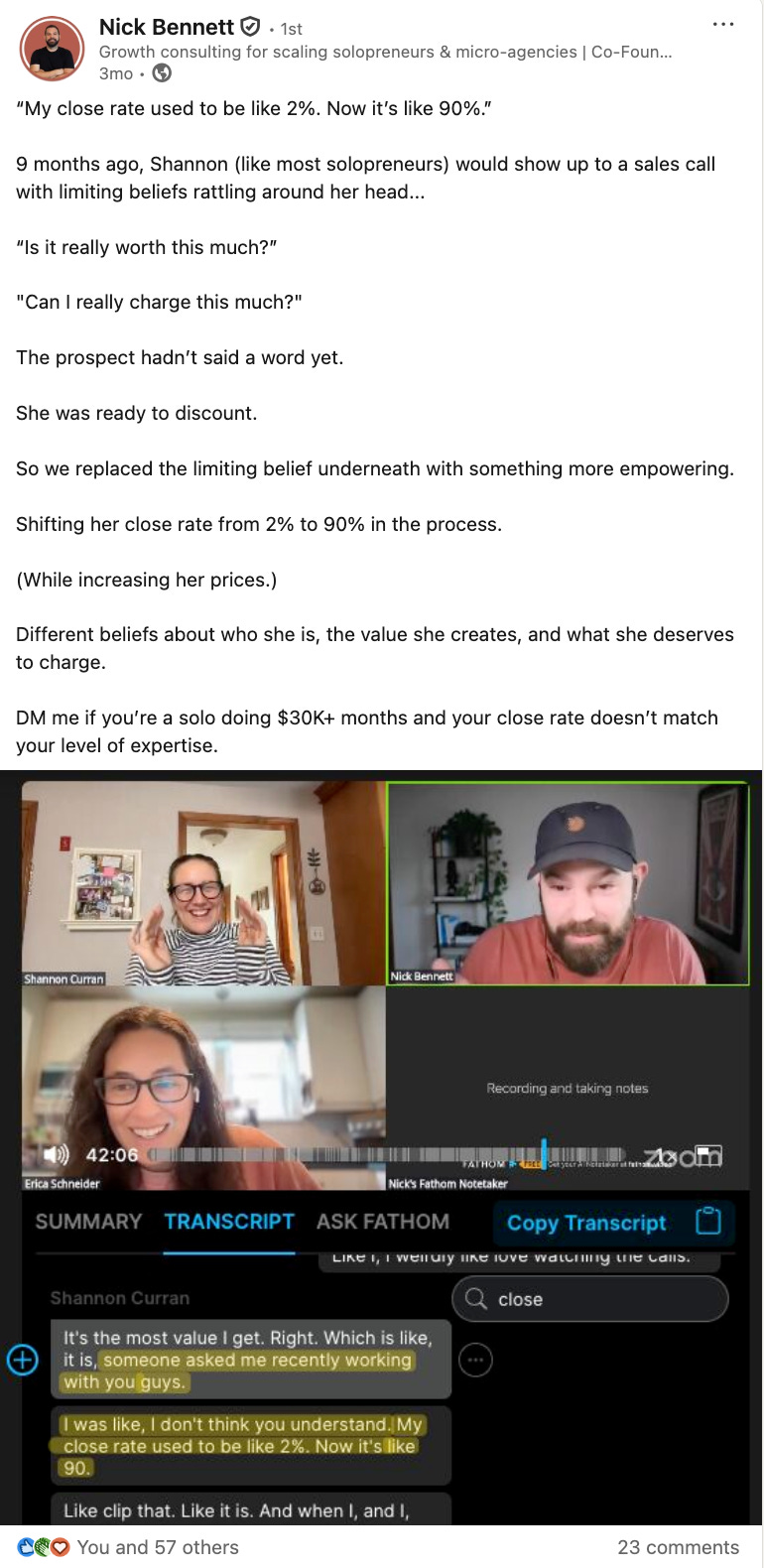
That jump in Shannon’s close rate came down to one thing, and one thing alone: structure.
We helped her build a sales process she could trust, so she didn’t have to improvise everything after “hello.”
The process works because buyers are more predictable than you think.
Every single buyer wants to know five things, in the same order.
What do you do
How do you do it
How are you different
What does it cost
How do we get started
This structure is the shape every good sales conversation takes, and once you see it, you can’t unsee it. We’ve run enough sales calls to see the pattern that leads a potential client to say, “When can we start?”
In this mini-book, you’ll see:
Why your sales calls feel chaotic.
The five-part discovery process that gets buyers to sell themselves.
How to pitch without dreading it.
Sales is predictable because people are predictable.
We’ve coached over 100 people on their sales process and have given feedback on more than 1,000 calls. The people who consistently close deals don’t improvise. They follow the specific Sales Model that every buyer is primed to go through before saying yes.
Once you realize people are predictable, you stop treating every sales call like a puzzle to solve from scratch.
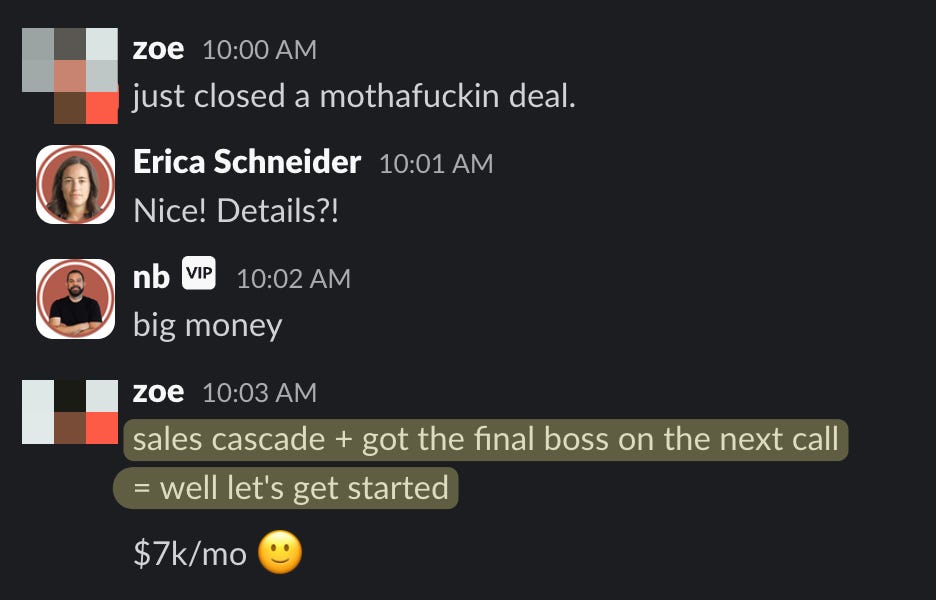
Nobody learned this lesson better than another client of ours, Zoe.
She’d been ghostwriting for years and was good at the work, but sales had never clicked. She’d get a buyer engaged, feel the conversation going well, and then lose them somewhere between “this sounds great” and “let’s get started.”
The Sales Model was one of the first things we taught her.
Once she learned it, her discovery calls stretched from twenty minutes to forty-five. She stopped rushing past motivation and aspiration to get to the pitch. The more discovery she did, the less convincing she had to be. Her pricing conversations got shorter. She stopped negotiating price and focused on confirming fit. She also stopped taking the bait when someone tried to pull her into tactics (”But how do you actually find my voice?”). She redirected them instead of chasing the question down a rabbit hole that made her sound less like a strategist and more like a button-clicker.
None of this required her to be a different person on calls.
She’s still the same sharp, occasionally chaotic writer she’s always been. The Sales Model just gave her energy a clear direction that works in her favor.
Let’s get into what we taught Zoe.
The Sales Model lets you control the call.
The Sales Model breaks down into two calls:
The first call is about discovery and direction, the transition, the pitch, and the close. This is where you do most of the “selling” work and either build trust or lose it.
The second call sets up the game plan. You usually schedule this during the first call, once the deal has momentum.
For now, we’ll focus on the first call because most deals are won or lost there.
It has four parts:
Discovery and direction. Here, you learn what’s true about the buyer and steer the conversation toward a natural transition.
The transition. This is the short bridge between discovery and the pitch, where you hand the conversation back to the buyer before you start talking about what you do.
The pitch. This is where you answer the five questions every buyer wants to know, so the next step feels obvious, not pushy. We know everything “hates” pitching, but pitching gets a bad reputation it doesn’t deserve. As sales writer Anthony Lannarino puts it, selling isn’t something you do to someone. It’s something you do with them and for them.
The close. This is where you find out if the deal moves forward, and where most people either surface objections or lose the deal to their own nerves.
Part 1: Discovery and Direction
Most people think discovery means learning things about the buyer.
That’s only half of it. The other half is direction. You land the conversation somewhere specific, so you can move cleanly into the pitch.
Discovery and direction happen in five steps:
Motivation: Why are they here, right now, today?
Aspiration: Where are they trying to go?
Situational alignment: What’s true about their business at this moment?
Size the prize: How big is the opportunity, in their own words?
Success criteria: Do they match what your best clients have in common?
Run these in order, and you’ll be able to transition cleanly into the pitch. Skip one, or run them out of sequence, and you end up talking at someone who never asked to be talked at.
Step 1: Motivation
The goal is to look backward. Why are they talking to you? What happened that made them reach out?
Don’t ask what their problem is. You’ll get a clean, logical answer that doesn’t tell you much. “Our paid ads aren’t converting” is a problem. It’s not a motivation.
Motivation is emotional, not tactical. It’s what pushed someone from thinking about their problem to doing something about it today instead of six months ago. Ask for it directly, and ask it the same way every time. That consistency matters.
Every motivation you collect in a call is data.
Structure the question the same way across every call, and you build an archive of what moves your buyers to act. That archive shapes your content, positioning, and offer far more than guessing ever could.
Examples of strong motivation (backward-looking, emotional trigger points):
Example 1: “My biggest client texted me at 9pm on a Sunday to say they’re pausing the retainer. I’ve been putting off building a real pipeline for two years because referrals kept bailing me out. They’re not bailing me out anymore, and I just lost 50% of my recurring revenue.”
Why it’s strong: She’s stating a specific event, a specific moment, and an admission of what she’d been avoiding.
Example 2: “I turned 40 last month and did the math on what I actually made per hour this year. It’s less than what I made at my old job. I can’t keep working this hard and still make less than I did in-house. Something has to change. “
Why it’s strong: They shared a concrete trigger (the math) tied to an emotional reckoning, “something has to change.”
Example 3: “My husband asked me what happens if I get sick for a month and can’t work. I didn’t have an answer. That’s the first time I’ve been scared about this business instead of just tired.”
Why it’s strong: It names the exact moment fear replaced fatigue, and it’s backward-looking.
Examples of weak motivation (stating tactical, logical problems only):
Example 1: “Our conversion rate on the website is only about 2%, and we think it should be higher.”
Why it’s weak: This is a stat, not a moment. We’ve got no sense of why they’re dealing with it today instead of last quarter.
Example 2: “We don’t really have a consistent content calendar right now.”
Why it’s weak: This describes a gap, not a trigger, and it could have been said at any point in the last two years.
Example 3: “I’m looking for ways to generate more qualified leads for my pipeline.”
Why it’s weak: This is what a buyer says when asked “what’s your problem,” not “why are you here today.” No emotion, no event, no urgency.
If you’re only getting weak motivations, push one layer deeper. “Why now instead of six months ago?” for example.
Once you have a strong motivation, you’re ready to look forward.
Step 2: Aspiration
Where are they trying to go? What do they want out of working with you?

This is where you learn what winning looks like to them, not what you assume it looks like.
Two buyers can have the exact same problem and completely different aspirations. One wants to stop doing something. The other wants to start doing something new.
Treating those as the same conversation is how you pitch the wrong thing to the right buyer.
A “stop” buyer is buying relief.
A “start” buyer is buying possibility.
The rest of your call needs to follow the direction they’re facing.
Say two agency owners come to you with the same problem: they write every piece of client content themselves.
The first tells you she wants out of the delivery seat, full stop. She’s fried. With her, you sell subtraction: the hours she gets back, the process that runs without her, the vacation where nothing breaks. You don’t need to get into business growth right now. Save that conversation for after you put out the burning fire. So here, your next question could be: “If those ten hours came back tomorrow, where would they go?”
The second owner wants to free up capacity to grow the business by 100% so she can install a pool in her backyard. Same bottleneck, opposite energy. So with her, you sell addition: align on what the freed-up time makes possible and how fast you can get her there. Your next question: “What’s kept you from freeing up capacity to take on more clients already?”
Pitch relief to the builder and you sound small. Pitch growth to the burned-out one and you sound exhausting.
Step 3: Situational alignment
Anchor to the present. What’s true about their business right now?
This includes the hard facts (revenue, team size, sales cycle length, and how the business makes money) and the soft ones (what they’ve already tried, what’s currently working, and what isn’t). These details matter.
The hard facts tell you if they can afford and support what you do.
The soft facts tell you if they’re ready to change.
This step is also when you check client fit, without saying so out loud. Does this business have the traits your best clients tend to have in common? If the answer is no, you’ll know not to move forward before it becomes an awkward conversation. If the answer is yes, you’ll know to move on to the next step.
Step 4: Size the prize
Help them see the size of the opportunity, with one caveat: they have to see the prize for themselves.
Most buyers know something feels off, but they’ve never sat down and calculated what fixing the problem is worth to them. If you tell them the number, it’s your claim, and they’ll weigh it accordingly.
If they arrive at the number themselves, they now own that fact.
Say you’re on a call with a VP of Sales at a B2B SaaS company. Leads come in from the website and land in a queue nobody owns. Their routing is a mess, everything is done manually, and they know they need automations yesterday.
To help him size the prize, walk him toward the cost one question at a time.
“How many inbound leads came in last month?” Two hundred.
“When one comes in, who does it go to?” Whoever grabs it first. Usually.
“How many never get grabbed at all?” He checks his spreadsheet. Maybe forty.
“And what’s your average deal worth?” Eighteen grand.
Then, stay quiet, and let him multiply. Forty orphaned leads a month at eighteen thousand each. Even if routing rules and automatic follow-up close just three of them, that’s fifty-four grand in new contracts every month. He says it out loud, in his own voice, doing his own math.
Every figure in that sentence came from him. He can argue with your projections all day, but he can’t argue with his own arithmetic. For the rest of the call, your retainer gets measured against the fifty-four grand a month he just named.

Step 5: Success criteria
This is the step most people get wrong, because it’s where the instinct to reassure someone works against you.
If you’ve run the first four steps well, the buyer will ask you directly or indirectly: “Do you think we’re a good fit?”
The worst possible answer is yes.
Saying yes is 100% your bias, and every buyer can feel it. It makes you sound like you’re selling them, because in that moment, you are.
Instead, take yourself out of it entirely. Describe what your best clients have in common, objectively and matter-of-factly, and let the buyer measure themselves against it. Nick calls this the law of self-discovery: people trust conclusions they reach on their own far more than conclusions you hand them.
So instead of “you’re a good fit for us,” say something like: “The people who get the best results with us tend to have these things in common.”
Then, stop talking and let them self-assess. When it lands, you’ll see it happen.
They start nodding along to their own checklist: We have that, we have that, we have that.
This step lets you screen for ideal client traits, so define your success criteria ahead of time. By the time you verbalize it in a call, you already know the answer. But it gives your buyer the chance to realize it too.
Now, you have to hand the conversation back.
Part 2: The Transition
This is where most sales calls fall apart.
You’ve just spent 20 to 30 minutes in a genuinely good conversation. Then, there’s a silence where neither person knows what happens next…
A lot of solopreneurs break it by saying, “I guess I should tell you about us now.”
Two moves fix this.
First, create space. Ask something broad and open-ended: “Is there anything else you think I should know?” Buyers will tell you things you never thought to ask about. It also gives them one more moment of being heard before the conversation shifts gears.
Second, invite direction. Ask, “What questions do you have for me?” This hands the wheel back to the buyer, and it tells you how much they know about buying something like yours. A buyer who’s never purchased a similar service will ask completely different questions than one who’s done it a dozen times, and that shapes how you run the next part of the call.
No matter who you’re talking to, remember one thing.
Don’t take the bait.
Somewhere in the transition, a buyer will try to drag you into the weeds.
They’ll ask a tactical question. “How do you find my voice?” Or “What’s your process for keyword research?” Or “Walk me through exactly how you’d set this up.”
It feels like curiosity, but it’s a trap.

The second you take the bait, you switch from a strategist to someone who clicks buttons. You’ll answer one tactical question, and then another, before you find yourself explaining your entire process in detail.
DON’T DO THIS.
Buyers care far less about how you do things than why you do them. Yes, they asked the question, but that’s because they don’t know how to buy from you, so they think they need tactical answers. They don’t. We have never seen someone out-tactic a competitor for the win. It always comes down to who has better strategic answers and who can earn more trust.
So, stay at the level of strategy. Acknowledge “bait” questions, answer them at a high level, and redirect the conversation back to wherever it left off.
You can always go deeper later, once they’ve decided to trust you.
Part 3: The Pitch
As we stated earlier, pitching gets a bad reputation it doesn’t deserve.
When we pitch, we never feel cringey, and once our clients learn the model, they don’t either.
Here’s how: explain what you do with five talking points, always in this order.
1. What do you do? Keep it plain and simple. A few sentences, max.
Here’s what we say at Duo:
We’re growth consultants who turn solopreneurs into micro-agencies. We help people at the 30k to 50k MRR mark scale up to 100k to 200k MRR.
2. How do you do it? This is where your model or methodology lives. If you’ve written about it elsewhere, reference it instead of re-explaining it from scratch.
Here’s what we say at Duo:
We work through 3 simple phases:
Phase one is your offer. We get clear on the problem, the person, and the process, so everything you market, sell, price, and deliver runs off the same baseline. That takes about a month.
Phase two is your pipeline. Content starts day one: we take most of the marketing off your plate through our MP3 process, and traction builds through month two and hits its stride in month three. We polish your sales process and SOWs so you close deals in one call, two if it’s a large firm.
Phase three is automation and delegation. We map every task you no longer want to manage and route each one to a person or to Claude. We install a Claude Code instance in your business with a core set of automations, then build you an AI co-pilot (ours is called Claudius) to help run your engagements. As you sell and serve clients, we help you sort what AI owns and what humans own.
Throughout the phases, we also include other micro-deliverables, like your website wireframe, that help us organize, align, and move things forward.
3. What does an engagement look like? Buyers want to know how you’ll interface with them. How often do you meet? How do you communicate? What are the deliverables? Being specific here does more work than being impressive.
Here’s what we say at Duo:
We meet once a week for an hour. We talk on Slack. And we use Notion for deliverables and staying organized. The most successful clients treat us like their non-equity co-founders and talk to us all week on Slack between meetings. There’s a direct correlation between how often we talk and how successful we are together.
4. How is this different? Almost nobody handles this one well, because almost nobody has the nerve to bring it up first. If you don’t tell a buyer how you’re different from the other people they’re talking to, they will invent a reason on their own, and it’s rarely in your favor. Most buyers won’t even ask this directly. They’ll just mention they’re “talking to a few other people” and wait to see if you take the hint.
Here’s how our client in the demand generation space answers this:
One thing that makes us different is we don’t just work in the ad platforms. Our engagement also covers inbound HubSpot help. So basically, what happens to those leads when they get in the system—all of the dashboards, reporting, automations, and flows. We track which leads came from which keywords, but we also go further to see whether they are actually turning into MQLs and opportunities.
Also, every single one of our clients is in verticalized B2B SaaS or niche B2B SaaS. Anyone who says that they can do both B2B and B2C is lying to you. B2B and B2C marketing genuinely don’t overlap much. B2B: long sales cycles, MQLs, demo requests, account-based targeting. B2C: impulse conversion rates, average order value, mass-market ad spend. An agency good at one usually isn’t good at the other.
5. What does it cost? You need a number you can quote on the spot. If you can’t, it’s a sign your business model needs to get simpler.
Price is one of the toughest parts of the pitch. When Erica first got on sales calls before she teamed up with Nick, someone asked her price. She explained and justified the number before they’d even reacted. The prospective buyer actually stopped her to say, “I know you’re a new founder, so take my advice: don’t ever explain your pricing.” It was awkward, but it was an important lesson. So in case you haven’t heard it, take this to heart:
Explaining a number invites a negotiation you didn’t need to open. The second you justify your price, you’ve told the buyer it’s up for discussion. You start playing defense and give up control of the call, which makes you look uncertain about your offer.
Erica never explained her pricing again (and we tell all our clients to do the same).
Part 4: The Close
Deals are lost in a specific order: first to inaction, second to happy ears, and then to everything else.
Happy ears happen when someone’s vibing with you on a call, and you let it replace your process. The buyer says something like: “I love this.” “Can’t wait to get started.” Or, “This is exactly what I need.”
None of that matters. The second you like what you hear and think this one’s in the bag, you’ve lost the deal. You stop listening critically. You stop asking the questions you’re supposed to ask. You skip steps. You don’t tell buyers the price because you’re too excited to remember to say it, and then the buyer sees a contract with a number they never agreed to, and the whole thing falls apart.
Every client we’ve worked with (ourselves included) has had happy ears.
A prospect who used to be an AI director at Microsoft once reached out to Erica. When Erica saw her DM on LinkedIn, she pictured the whole future with this person before getting on a sales call. They’d be an incredible client, an easy win, and a referral machine for years to come. So, she texted Nick something like, “OMG, amazing lead just came in. This could be huge!”
Months later, Erica saw her mistake.
“She was not right for us, but we said yes because of her title and my happy ears.”
Happy ears hijack you and take control of the conversation. Erica assumed the client was a good fit before they ever met. Which means she couldn’t run the model in an unbiased manner.
This doesn’t mean you can’t feel great about upcoming sales calls. But it does mean you need to stay level-headed and run the same close every time, whether the buyer is gushing or silent.
How to close well
Once you’re clear of happy ears, closing comes down to three moves.
Run them in this order, every time. The goal is a clear commitment. Either the deal moves forward, or you both know exactly where it stands.
1. Ask if your offer solves the problem.
“Based on everything we discussed, does this sound like it solves your problem?”
Most people are afraid to ask this, but it doesn’t need to be scary. You’re not wheeling and dealing on a used car lot. You’re just trying to understand where things stand. If the answer is yes, you’ve gained a commitment. If it’s no, or they need more information, ask what information they need.
Either way, you know where you stand instead of ruminating about it after the call.
2. Ask what’s holding them back.
“Is there anything holding you back from getting started?”
People will tell you. “My CMO has to sign off.” “I need to loop in my partner.” “I want to see one more proposal.” Once you’ve surfaced any objections, you can work to answer them.
Left unspoken, objections often kill a deal.
3. Ask one more time, directly.
“Is there any reason you wouldn’t do this with us?”
This gives buyers one more chance to object and ask questions.
If none of that surfaces an objection, and the buyer still isn’t ready to commit, send them to a reference check. Have them talk to an existing client between now and your next call, someone who’s already done the thing and seen results. Almost nobody does this, and that’s exactly why it works.
Buyers who take a reference call are almost always ready to move forward by the time they get back to you.
This is risk management, not a favor. Buying from a solopreneur is a leap of faith, and a reference call closes the gap between what you’re claiming and what a stranger can independently confirm. Keep a small handful of your best clients on hand for this. It’ll do more for your close rate than almost anything else in this section.
Every one of these questions leads somewhere useful.
You either close the deal right there, or you surface what’s standing in the way and get the commitment to move to the next call.
When they want in, and you don’t.
Sometimes, the hardest part of the Sales Model is not closing, on purpose.
This happens when the buyer is excited and ready and you know they’re not the right fit. The instinct is to soften it into nothing, or take the deal anyway because saying no out loud feels worse than it should. Don’t do either.
Instead, name what’s missing, then point them toward a better next step, like referring them to someone else.
You don’t want to bluntly tell someone they’re not ready. But you can tie the no back to the success criteria you laid out earlier in the call. Something closer to: “Based on what we’ve talked through, I don’t think you’re at the stage where this makes sense yet, and here’s what I’d want to see before it does.”
This happened to one of our own clients recently.
A prospect came to him wanting out of the sales process. Our client took one look and told him flatly: he wasn’t anywhere close to ready to get out of sales. He needed to get better at it first, not hand it off. So instead of taking the deal, our client sent him to us. That prospect wasn’t a bad lead for our client, but he was early.
Sending a client to the right next person, instead of closing them, is often better for the long-term relationship. Taking someone who isn’t ready doesn’t help either of you.
It usually costs you both time and money you didn’t need to spend.
Learning the model is step one. Not abandoning it is steps two through forever.
Competence is the trap. We’ve seen our longest-standing clients run the process a hundred times, and the second they go with their gut over structure, they talk fast, skip straight past discovery, get happy ears, and botch the call.
So we’re going to leave you with this:
Always read the teleprompter.

News anchors read the teleprompter every single broadcast. Twenty years in, material memorized, they still read it line by line, because reading it every time is how they got that good and how they stay that good.
That discipline separates people who learned the model from people who close with it.
Cheers,
Nick, Erica, & Katrina
P.S. – Ready to speed up the transition from consultant to real company? Book a call with Nick and Erica.
P.P.S – Want to share your unique POV with mini-books like this one? Book a call with Katrina.
Have questions? Ask us in a comment below.
The distinction between motivation and problem, motivation being emotional and backward-looking while a problem is just a stat, is one I've been conflating in my own outreach. I ask people what's frustrating them and get a logical answer, without ever asking why now instead of six months ago.
Buyers already ask the same things in the same order. The founder who improvises after hello is the one making a pattern look like chaos.