



Welcome to How Solos Scale. Each week, we share a new framework, concept, or example of how solopreneurs & micro agencies are scaling from $30,000 to $100,000+ per month.
Hey there,
We want to start by telling you how we met Michelle Warner, a co-thinker of this mini-book.
Our relationship didn’t start with a cold pitch or a well-timed LinkedIn post.
It started when our friend Jay Acunzo told her story on his podcast, Why We Resonate (previously Unthinkable). As routine listeners, we trusted Jay. So when he talked about Michelle and how she thought about marketing, we paid attention. We looked her up and followed her work.
A while later, Nick joined Jay’s Creator Kitchen program (RIP) and met Michelle when she hosted a workshop for the group. This reaffirmed their shared beliefs around how business should be done.
A year after that, Nick and Erica hosted Jay in their (also defunct) group coaching program, Full Stack Solopreneur. And yet again, Jay referenced Michelle in his slides.
When the time came to bring someone in to help us think through our own business strategy, a few months after we founded Duo, the decision was easy.
We chose Michelle.
We didn’t need to vet her, ask for three reference calls, or do a trial project. We just needed to know if the fit was right.
If we were a good fit for her.
Michelle calls this “confirming logistics.” The sale was already done. We had been building mutual trust for months, in the background, without either of us doing anything that felt like marketing. When we finally got on a call, we didn’t have to prove ourselves to each other. We just figured out logistics.
Since then, Nick has hosted Michelle on his podcast, 1,000 Routes.
And now we’re here, co-writing (and co-thinking) this mini-book together.
Needless to say, relationships matter.
Most solopreneurs know the power of referrals. They know relationships matter. But few have a framework for building them intentionally, or understand how different that approach is from the way they’re currently trying to grow.
That’s the foundation of Relationship Marketing.
Relationship Marketing means earning trust through genuine connection before you ever make an ask.
It works best for high-ticket, high-trust services where the buying decision is personal, the relationship matters, and referrals drive (on average) about half of the pipeline.
Michelle has built her consulting practice this way. She doesn’t have a sales team. She doesn’t run ads. She grows her business by showing up in the right rooms, saying things that stick, and staying in contact with people she cares about.
We’ve done the same.
The clients who work with us often find us in the same way Nick found Michelle. They heard or saw something that resonated. They followed our work. And when the timing was right, they reached out.
We’d been marketing this way for years, but we never had a name for the approach. Working with Michelle helped us see it clearly. This mini-book is a collaboration and a Relationship Marketing move. It exists because of the relationship we’ve built with Michelle. You’re reading it because of the relationship we’ve built with you.
Once you see this approach, you start noticing it everywhere.
Let’s get into how and why it works.
Traffic Marketing vs Relationship Marketing
All marketing activities exist on a spectrum. At one end is relationship marketing, and at the other is traffic marketing.
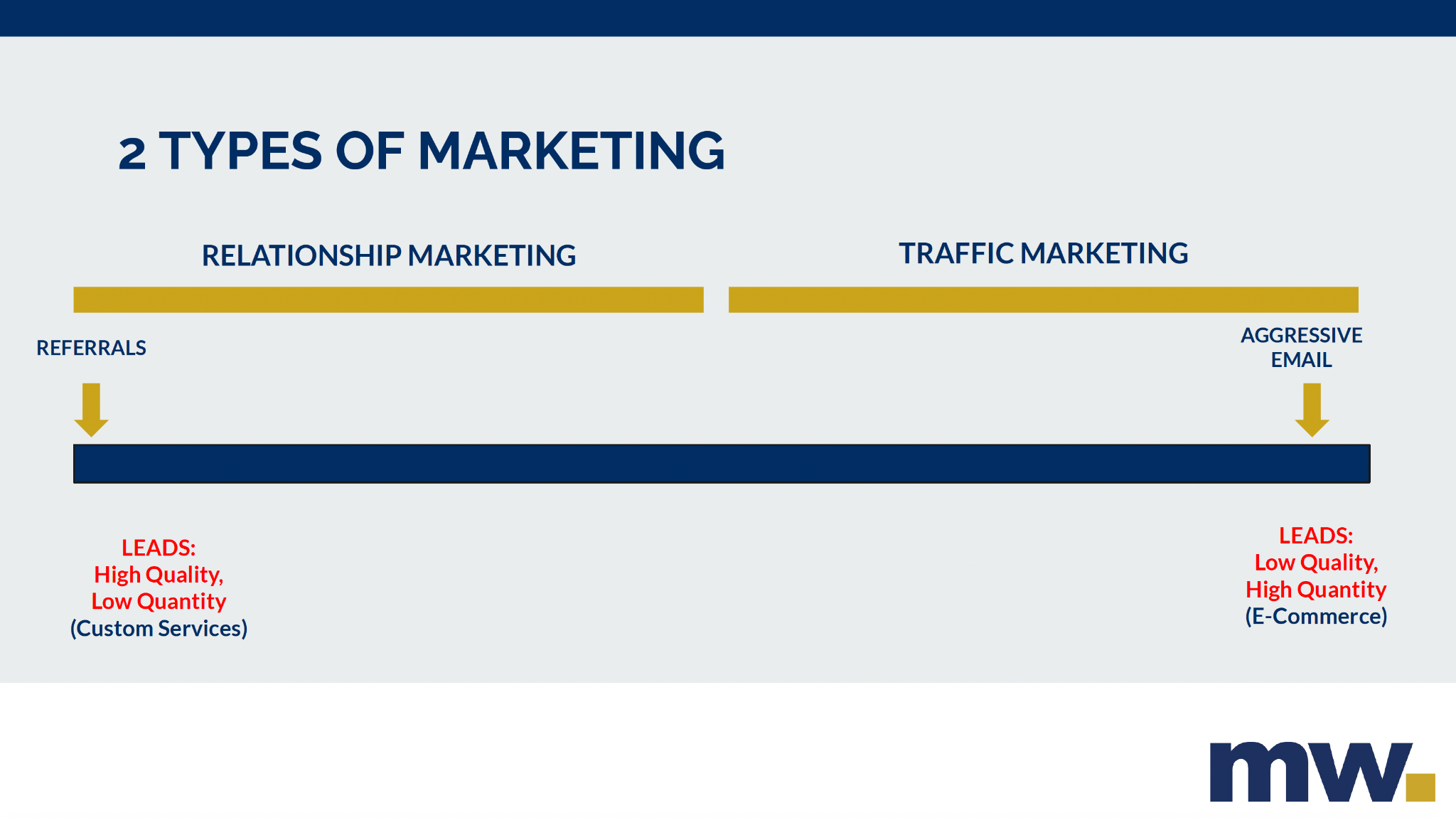
Traffic marketing is built for volume. You cast a wide net, collect numbers, and bet that enough of the right people will find you. It’s why most marketing advice tells you to post consistently, grow your audience, and optimize for reach. For low-ticket, high-volume products (like e-commerce, a paid newsletter, cohorts, or a $157 course), this makes sense. You need a lot of buyers for the math to work, and traffic gets you there.
Relationship Marketing is built for quality. You don’t try to reach everyone. You try to reach the right people, in the right rooms, with enough impact that they remember you. For high-ticket, high-trust services where a single client relationship is worth tens of thousands of dollars (like B2B services or consulting), this approach works wonders.
The goal of Relationship Marketing is to meet the right people and do so with impact.
We constantly meet solopreneurs with 80,000 LinkedIn followers who can’t close a deal or are bombarded with bad-fit sales calls. They post every day, chase impressions, and wonder why their pipeline feels random and inconsistent. A high follower count feels like proof that something’s working. But Michelle says followers can give you false confidence.
What gets measured gets managed, and traffic marketing gives you a lot to measure. You can track impressions, likes, and reach. So it’s easy to feel like you’re marketing when, really, you’re just checking off a to-do list.
Relationship Marketing doesn’t give you false confidence because it’s tough to do well.
It involves another person, which means you can’t fully control it or automate your way through it. You’ve probably gotten an automated LinkedIn DM that lands seconds after you connect with someone new. Most are clearly automated sequences, with “personalized” outreach that uses only your first name. Nobody’s fooled.

Just…no.
That’s why most people avoid Relationship Marketing and exactly why it works.
The difficulty is the magic.
Marketing gets harder every year.
This misalignment between your business model and your marketing approach isn’t new. But the cost of getting it wrong keeps going up.
Before 2018, you could run traffic-based marketing for a high-ticket service and still get clients. The markets were less saturated, buyers were less savvy, and there was enough signal in the noise that even a misaligned approach could work. Relationship-based businesses could run traffic playbooks and still close clients. The rules existed, but breaking them didn’t hurt yet.
That’s not true anymore.
Today, buyers tune out content they don’t trust. Traffic marketing works less and less for relationship-based businesses. You pay a price (in terms of lost sales) for this misalignment. The gap between what your business needs and what your marketing delivers gets more expensive to ignore every year.
The environment you’re marketing in also keeps getting noisier.
Think of it like training your dog. You start inside the house, where it’s easy to avoid distractions. Then, you move to the backyard and have to deal with a squirrel. Eventually, you’re in the middle of a park with kids and squirrels and picnics everywhere.
You still have to get the dog to pay attention to you. It just takes a lot more effort.

AI has accelerated this chaos. Content is everywhere. People post five times a day. There’s lots of parasocial noise and AI slop. The market is louder than it’s ever been, and high-ticket services buyers are more skeptical.
If you want to win in this environment, you need to overindex on building trust.
Which side do you lean towards?
In our experience, most solopreneurs and micro-agencies run traffic marketing playbooks on relationship-based businesses.
If every marketing strategy sits on the continuum between pure traffic and pure relationship, every business model does too. The game is alignment. You want your marketing approach to align roughly with your business model. The tactics that work sit in the middle of the marketing spectrum, but they’re closer to the relationship end than most people think.
The clearest example in the B2B marketing space is Chris Walker.
People looked at what he built at Refine Labs and thought, “He has a great LinkedIn presence and a podcast. Therefore, I should build a great LinkedIn presence and a podcast.” But that’s not why clients trusted Chris enough to spend $50,000 retainers. It was because he ran live events every Tuesday night and built relationships with the people who showed up. The content made him visible. The relationships made him a real human person worth hiring at a (very high) premium.
If you just copy his visible “traffic” strategy, you miss the relationships that matter.
Here’s the counterargument: “But Chris Walker had both. Doesn’t that prove you need both?”
No. (And we’d push back on anyone who says otherwise.)
More followers don’t move the needle the way you’d think. We’ve seen this firsthand. Our clients have between 1,500 and 90,000 followers. But if we look at the revenue across that range, the smaller audiences often outperform larger ones.
Why? Because clients with bigger audiences feel like they have to keep hitting the impressions lottery. So they drift toward broad topics everyone can relate to.
That’s the wrong content to be making if you sell a high-ticket service.
It has a place, of course. But it should only be a fraction of what you put out. If you’re used to feeding a big audience, you often over-optimize for broad content because it feels physically painful to see lower impressions. Erica experienced this firsthand as she made the shift, and all of our larger-audience clients have lamented some version of this pain.
Our content strategy today is simple:
We run a podcast, but we don’t track downloads. Erica has a big audience, but she isn’t bothered by impressions. We share mini-books (like this one), but we do nothing to aggressively grow our subscriber base.
We measure one thing: the number of good conversations our content starts.
The moment you start optimizing for views or downloads or chasing sponsorships, you’ve switched to a traffic business model. That’s a different game than the relationship business model. (It’s your choice, of course. Traffic businesses work for many people.)
But if you’re like us, you don’t need or want both. You need to be highly visible to a very small number of the right people.
The question is how to do that well.
The 3 Stages of Relationship Marketing
Relationship Marketing works in three stages: awareness, engagement, and sales. Each one builds on the last. Get all three right, and the sale is a matter of confirming logistics.
1. Awareness gets you in front of the right people.
A lot of solopreneurs assume that if they post enough, share enough, and show up consistently enough, the right people will eventually find them. That assumption drives content calendars and LinkedIn strategies that produce impressions, not clients.
Relationship Marketing starts from a different premise.
Don’t wait for people to find you. Go where they already are.
The goal here is access. Instead of broadcasting and hoping you reel in the right clients, you find the rooms where they already gather and figure out how to get inside.
Michelle calls this “borrowing an audience.”
You can “borrow” by guest teaching inside a membership, speaking at a lunch and learn, getting on a podcast, inserting your curriculum into a business program, or partnering with a university to teach inside an executive MBA. Slack communities work, as do industry forums, alumni networks, and peer groups. A one-on-one introduction also counts (it’s often the best play if you sell to senior decision-makers).
The format varies, but the principle is the same. Find where the right people gather and show up there with something worth saying. The channels are everywhere once you start looking for them.
But showing up in the room isn’t enough on its own.
The Awareness Pie
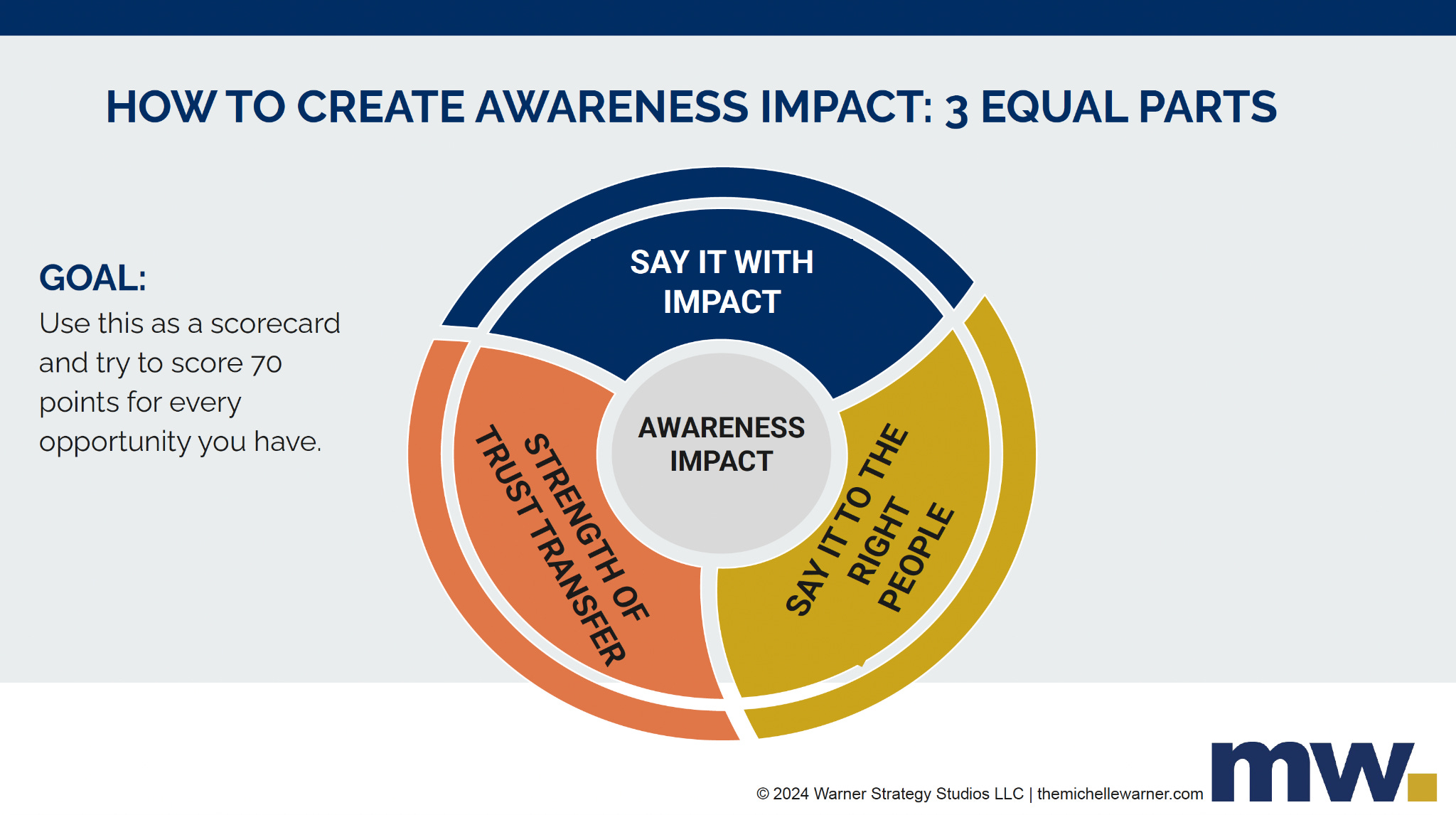
To make awareness work in Relationship Marketing, three things have to come together. Michelle calls this the awareness pie:
The right room, with the right people: This is the specific audience where your best potential clients are concentrated. In a B2B context, it’s easy to get in front of a division leader who has no budget and no authority. It’s harder to get in front of the CEO who does. The discipline is choosing rooms that give you access to the people who can hire you, not just rooms that look impressive.
A strong trust transfer: You want the person who owns or runs that room to introduce you and endorse you. At a minimum, it should be someone whose audience already knows your name. The warmer the introduction, the faster the trust builds.
An impactful statement that productively haunts them: When you get into a room, the instinct is to teach. So you share useful things, give a framework, and send people away with action items. That instinct is mostly wrong. You want to say something so specific and resonant that people can’t stop thinking about it after they leave. When they go back to doing the thing you named, they hear your voice.
For example, Michelle “productively haunts people” when she speaks to service providers who tell her their marketing isn’t working. She asks: “Have you heard of Relationship Marketing?” They go back to their content calendar, nothing converts, and there’s Michelle’s question sitting in the back of their head.
You want to create something that lodges in their mind and surfaces every time they repeat the old behavior.
Most people are very good at their work and very bad at describing it in a way that sticks.
If you have a strong point of view, that’s the raw material. If you struggle to articulate what makes your thinking different, that’s the work to do before you start booking guest appearances. It’s rare to find someone with no point of view who’s also doing exceptional work because point of view and quality tend to go together.
The problem is that many people have a perspective they haven’t yet learned to surface.
Nick learned this lesson the hard way.
At one point, Duo had four clients who were all part of the same creator management company. That’s a clear signal that something is working with that audience. So Nick reached out to the founder directly. He told him four of his creators were working with Duo and thought that would be enough to start a conversation.
The founder said “cool” and nothing else.
What went wrong?
Nick should have asked those four clients to reach out to the founder simultaneously. Each of them, separately, telling him the same thing: “Working with Duo changed something for me.” That’s a trust transfer. Instead, Nick name-dropped the clients, which has almost no value to someone who didn’t ask.
Michelle once made a similar mistake. She reached out to someone after a mutual contact suggested it, got the same flat response, and let it sit. A few months later, she went back to her clients who were in that person’s program and asked them to speak up. They did. She’s been teaching inside that program for a year.
Trust transfers have to come from the right direction.
When someone your audience already trusts says, “You need to hear from this person,” you immediately inherit a heaping portion of trust. The audience extends you the benefit of the doubt before you’ve said a word. That’s how Nick found Michelle. Jay talked about her on his podcast, and Nick already trusted Jay. The trust transferred.
That said, you can build trust and authority through content. We explain how to do this in The Recognition Engine mini-book.
Of course, you need both. Build relationships behind the scenes. Build recognition in public. The referral gets someone to look. The content makes them sure. (This also works vice versa.)
2. Engagement helps you give people a map.
When someone discovers your work and starts paying attention, they don’t need more information. They need help making sense of their own situation.
Michelle recommends using a diagnostic. You take whatever someone learns at the awareness stage and help them see where they stand. It can be an audit, a self-assessment, or a simple framework that lets them place themselves on a spectrum. The format can be almost anything. A one-to-five ranking. A traffic light system. A two-by-two. Michelle has even seen bingo cards work, where people circle every symptom they recognize from a list.
Whatever the format, the function is to help people categorize their problem, see that it has a name, and understand that there’s a path out.
Michelle does this with a simple continuum.
She asks someone to describe their business, plots an X on the spectrum, then asks about their marketing and plots another X. When the two Xs are far apart, she says, “We’ve got a gap to close.” The person looks at the diagram and, often for the first time, feels like they’re not crazy.
That matters more than it sounds.
We do a similar thing in sales calls. Through our conversation, we give prospects the opportunity to talk through their pain, identify the gap that needs to be filled, and guide them through our framework for closing it. We’re not selling them anything; we’re helping them come to their own conclusion about whether we’re the right fit to solve their problems.
The special snowflake pattern
There’s a pattern every time Michelle works through the engagement step with someone.
First, something she said in awareness haunted them. They heard it, felt it land, and immediately tried to talk themselves out of it. That’s the special snowflake impulse: “My situation is probably different.”
Then, they see the map and find themselves in it.
Immediately, they feel relief.
Oh, this is a known problem. Other people have this. There’s a name for it. Some of the most powerful words on any sales call are, “I’ve seen this before. Every client we work with starts in exactly this spot.”
People don’t want their problems to be unique. They want their problems to be normal and their solutions to feel custom.
(Custom in the sense that it will work for their specific situation, not as in custom-scoped. We always opt for standardized solutions.)
The diagnostic gives them the first part, and your service delivers the second.
Intentions drive the engagement engine
Relationship Marketing works because people can feel your intentions. Not in a vague, mystical sense—in a very practical one.
For instance, Nick tries to message every new newsletter subscriber to say thank you. Someone once told him that it was cringe. His response: “It’s only cringe if you don’t mean it.” But his gratitude is genuine. A lot of subscribers write back and start conversations, and some of those conversations turn into clients.
Of course, staying in contact with the right people over time requires some infrastructure.
So if you crave organization, you can keep track of your conversations with a Relationship CRM.
It doesn’t have to be a complicated system, just something that keeps you from letting important relationships go cold. Our friend Renee Frojo has 90-day reminders set for everyone she’s had a meaningful conversation with. It’s just a way to check in. Katrina used to set Google alerts for every founder she worked with so she’d know when they raised money, launched something, or showed up in the news. It was a reason to reach out that was genuinely about them.
Some people bristle at this. “It feels transactional and too calculated.”
Michelle’s response is always to ask, “Do you keep a calendar of your family’s birthdays?” That’s not transactional. That’s care, supported by a system. You go out of your way to remember something that matters.
3. Sales confirms what’s already true.
If you focus on awareness and engagement, a sales call stops being a sales call.
There’s no pitch, objection handling, or sequence of follow-up emails. The person shows up already knowing what you do. They believe you can solve their problem. And they wonder if you’ll take them on.
The only question left is whether the fit is right and whether they can make the numbers work.
So when you ask, “Is there any reason you wouldn’t move forward?” The answer is some version of: “I just want to make sure I have the budget.” That’s the sale becoming logistics.
Michelle breaks the relationship sale process into three paths:
About half the people who go through the engagement stage self-select. They see the gap clearly and ask: “What does it look like to work with you?” You don’t have to do anything. They’re already there.
Another 25 to 30 percent are tracking. They’ve absorbed everything, they know they have the problem, but they’re not going to raise their hand on their own. For them, a gentle nudge works: “Would you be open to a conversation about what it looks like to fix it?”
The last path needs more time and a few more touchpoints. That could be a LinkedIn post, an email, or a low-pressure invitation to book a call. You can also throw in some light traffic plays to stay visible until they’re ready.
The vast majority convert through the first two paths. The final hard sell almost never comes up. That said, our clients have high price points, so even well-warmed prospects sometimes hesitate.
When that happens to us, we send them to Brian.
Brian is a long-term client who has been with us since near the beginning. He’s closed more revenue for us than we can fully calculate, just by picking up the phone and telling prospects the truth. “Yes, it’s real. Yes, it works. Here’s what happened for me.”
The reference call is the ultimate Relationship Marketing play.
It takes a warm prospect and hands them to someone they have no reason to distrust. The trust transfers and gets you one step closer to a closed deal.
Gratitude is not optional
We once had a referral partner who never said, “thank you.”
We sent them more than 20 deals over time, asking for nothing in return. We just wanted to know they acknowledged and appreciated it. But they never made that clear. After a while, we stopped sending them work. It wasn’t vindictiveness. It’s what happens when someone’s intentions come to light. They weren’t keen on building a working relationship with us. They simply saw it as receiving a service.
Gratitude keeps referrals moving, and the way you express it matters.
One way to do this is to send gifts tailored to the person. Michelle once bought a grove of trees for a sustainability-focused client because that’s what would mean something to her.
And when a referral partner sent us her best friend, we sent her cookies before we even knew if she would close. We were genuinely grateful that she thought of us.
She sent us a photo of her family eating them on a holiday.
(We’ve also sent Brian a lot of cookies.)
A branded company mug says, “We thought of our brand.” But a specific, personal gift says, “We thought of you.” Those two actions land very differently. A mug is like the sequence that arrives in your LinkedIn DMs three minutes after you accept a connection request. It’s the five-email follow-up chain after a sales call. It’s the timed discount that “expires” at midnight.
These tactics are optimized for conversion, not for trust.
In a relationship-based business, every manufactured touch chips away at the credibility you earned through awareness and engagement. The whole point of getting the first two stages right is to avoid having to do any of that to close the sale.
Don’t undo it at the finish line.
Relationship Marketing compounds over time.
Some relationships pay off in weeks, especially when the trust transfer does its job. Others are slow burns that take months or years to pay off.
Usually, it’s a mix of both.
The way we found Michelle isn’t a coincidence. Jay talked about her, we trusted Jay, and we paid attention. Two years passed. But when the time came to bring in a strategic partner, the decision was already made. (Not by us. For us, over time.)
This is why Relationship Marketing doesn’t look like marketing while it’s happening.
It looks like listening to a podcast, showing up at the right event, sending a thank you when nobody asked, or saying something in a room that sticks with one person long after they’ve left. The business outcome always shows up eventually. It just arrives on its own timeline.
This long-term approach is why relationships are tough to replicate and impossible to automate.
(Which means there’s hope for us humans after all.)
Cheers,
Nick, Erica, Michelle, and Katrina
P.S. – Ready to speed up the transition from consultant to real company? Book a call with Nick and Erica.
P.P.S – Want to share your unique POV with mini-books like this one? Book a call with Katrina.
P.P.P.S – Want to work with or learn more from Michelle? Head to Michelle’s website.
Have questions? Ask us in a comment below.
This was one of the most helpful reads I've done in a LONG time. It's the first time I come across "relationship marketing" and it makes sooo much sense. If someone is young and at the very start of their journey, how can they enter the awareness stage? Especially if they don't have many contacts in the space. Curious to hear your take on this!
wow wow wow, this was such an enlightening read. it gives me this beautiful renewed feeling of hope about what marketing gets to actually be, and it feels super wholesome and heartfelt. digital marketing has always felt a touch off to me and i think this really really hits the nail on the head for why. thank you for all of your incredibly thoughtful and empowering mini books!