



Welcome to How Solos Scale. Each week, we share a new framework, concept, or example of how solopreneurs are scaling from $35,000 to $80,000+ per month.
Hey there,
When Nick first went out on his own, he was hot on an idea: market the problem.
The idea was simple: show that you understand your prospects’ pain better than they do, so you become the obvious solution. Make the problem urgent. Make it compelling. Make it visceral.
So, Nick did exactly that.
He called his ICPs problem the “interchangeable agency problem”.
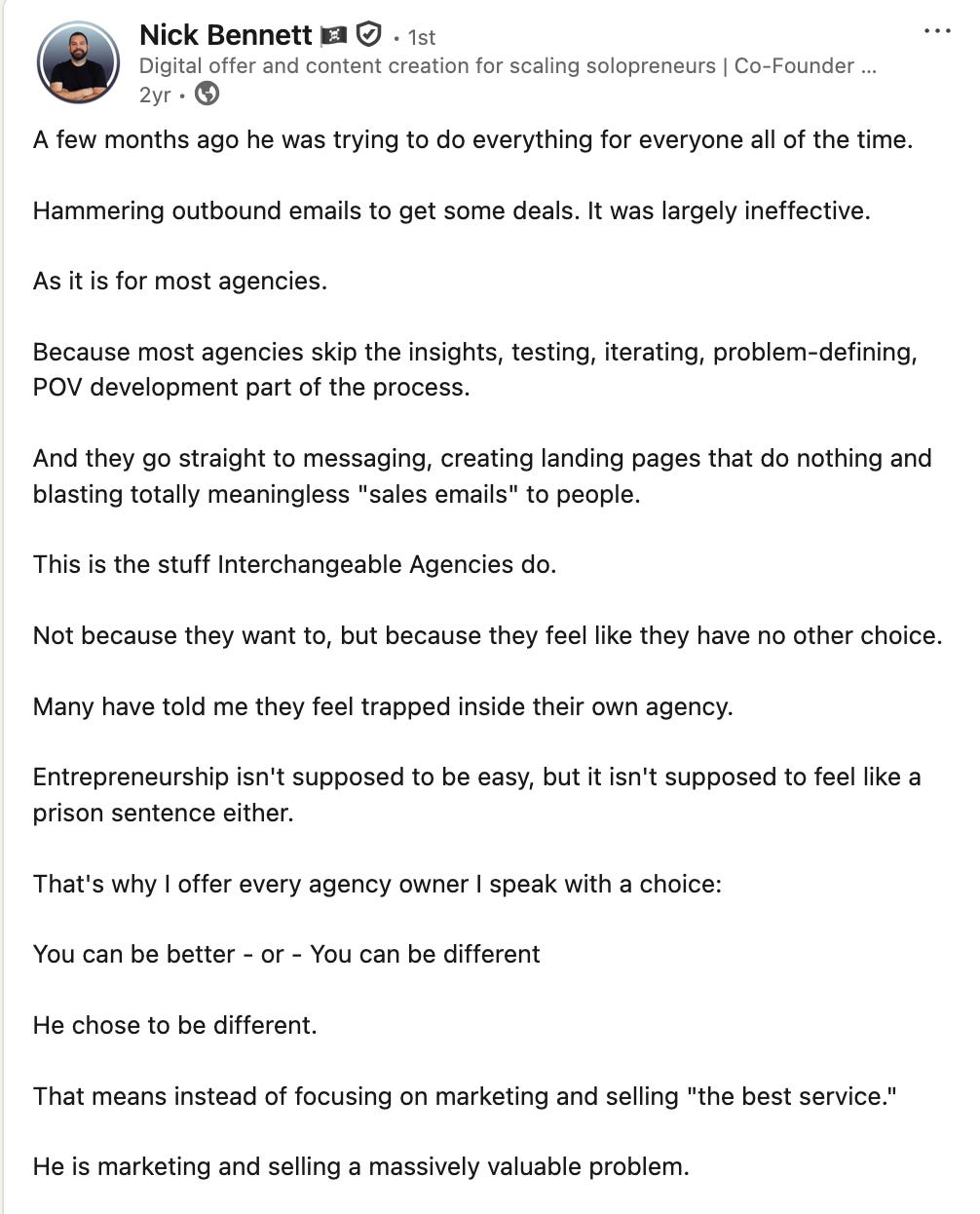
The concept was simple: There are a ton of interchangeable marketing agencies. They’re completely undifferentiated, so potential clients have no idea which one to choose, or why.
Nick framed this problem in a clear way:
“Nobody knows what problem you solve, so you struggle to get leads. Referrals come in, but you struggle to close them because you can’t explain what problem you solve or how you solve it. If nothing changes soon, you’ll have hard decisions to make.”
He got a boatload of inbound from this type of content. So, he kept writing about the problems agencies faced.
Everyone was going great until one day, he looked at his revenue and realized he had a problem of his own.
The Problem with Failure-Indicator Framing
Nick was framing the problems agencies faced through objective failure:
“You don’t stand out.”
“There are no leads or pipeline.”
“You’re running out of money, and you’re gonna have to lay people off.”
These are painful problems, and Nick got a ton of interest when marketing them. But his revenue stayed low. People wanted to work with him, but they couldn’t afford it.
He remembers thinking, “This is strange. How am I going to dig myself out of this hole?”
So he tried something new.
Instead of pointing out his ICP’s flaws and failures, he started framing their problems through objective success.
Instead of: “You have no leads and a dry pipeline.”
He reframed it as: “Leads are coming in, but they’re not sure what makes you different from the agency they just spoke to.”
It’s a subtle shift, but a critical one.
Failure indicators attract people who are struggling, down, and often looking for a parachute (quick fixes).
Success indicators attract people who are successful, but stuck, and often looking for a partner (sustainable fixes).
Almost as soon as Nick reframed the problem from failure to success indicators, the right clients started showing up, and Nick’s revenue grew like wildfire.
Years later, when Nick teamed up with Erica and started Duo, we noticed the same pattern showing up with our clients. Low buyer maturity. Low investment capacity. Prospects looking for a parachute instead of a partner.
It was the same problem Nick had solved for himself years ago.
That’s when he realized he was the case study. He’d lived through this exact shift—from failure-indicator framing to success-indicator framing. From attracting struggling buyers to attracting a completely different mature buyer tier.
Thus, the Elevate the Problem framework was born.
Nick finally shared his strategy with the world, and it became one of his most popular posts.
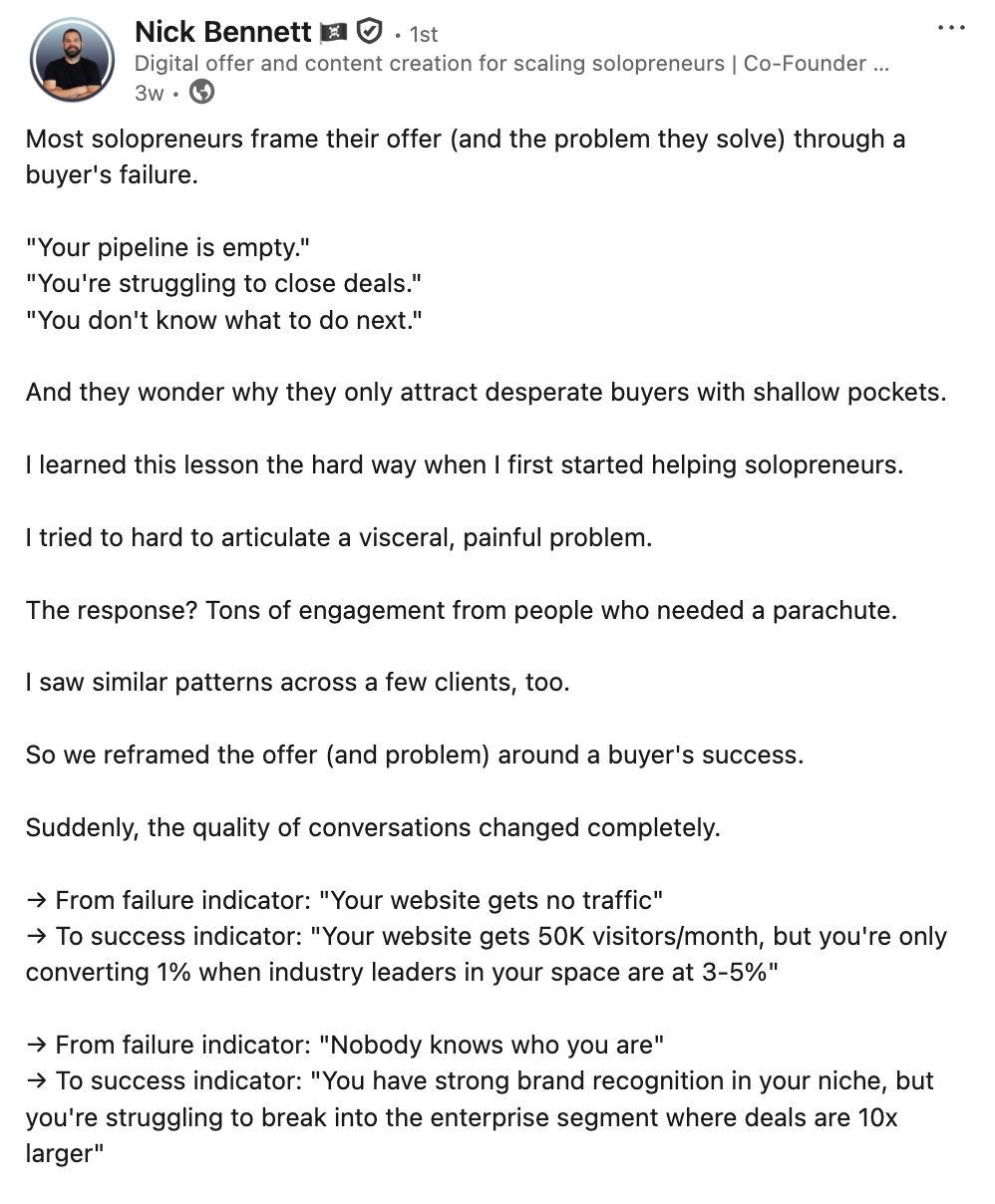
People asked, “When’s the podcast coming out on this? When’s the mini-book?”
And here we are.
Elevated problems attract upmarket buyers
If there’s a significant mismatch between what you want to charge and the maturity level of the buyers you’re targeting, your problem framing is off.
Because the words you use to describe the problem determine the buyers you attract.
That’s it. That’s the whole game.
If you frame problems through failure indicators (”no leads, no pipeline, running out of money”), you attract people in crisis mode who need a parachute.
If you frame problems through success indicators (”you have leads, but they’re not converting at the rate you need”), you attract people in building mode who want a partner.
This isn’t about one approach being “right” and the other being “wrong.”
If you want to serve early-stage solopreneurs, failure-indicator framing might be exactly right. That’s a real business serving a real need. But if you want to work with established solopreneurs, charge premium rates, and build a sustainable consulting practice, your problem framing needs to match that reality.
The rest of this mini-book breaks down how to make that shift.
You’ll learn:
The difference between failure indicators and success indicators (and why it matters)
How to diagnose whether your current framing is attracting the wrong tier
The formula for elevating any problem to attract more mature buyers
How this connects to the MP3 framework you already know
Real examples of how solos elevate the problem
Let’s start with the fundamentals.
The Difference Between Failure and Success Indicators
Before we proceed, we need to define success and failure indicators.
These aren’t a way to categorize people or shame anyone by saying their businesses suck. Often, there is a failure that took place (they don’t have leads, their revenue is low, they’re going to have to lay people off). But that doesn’t mean they are failures as people. The reverse is also true—just because you’re successful in some ways doesn’t mean you have it all figured out.
Instead, it’s about the mindset the two indicators create.
An example:
Failure indicator: “Your marketing isn’t generating any ROI.” If your marketing is generating zero ROI, you’re either a down-market, early-stage company or a person who hasn’t figured out their marketing. That’s what it implies, whether or not it’s true.
Success indicator: “Your marketing generates consistent ROI. But your client load is at capacity, and you can’t scale past it.” This is a completely different situation. You’ve brought specificity into it. You’re attracting someone who’s hitting a ceiling at a very specific place and wants the elevated problem solved.
Intentionally choosing your framing is the whole point here. If you want low-ticket, less mature buyers, failure indicators work well. If you want high-ticket, mature buyers, success indicators are essential.
So if you’re wondering, “I’m not sure why I only get people who are on the brink…”
This will clear up the confusion.
Failure Indicators: When Problems Signal Crisis
Failure indicators frame problems in terms of objective failure. They signal that something has gone wrong, something is broken, or urgent action is needed.
Common failure-indicators sound like:
“You have no leads.”
“You have no pipeline.”
“You can’t close deals.”
“You’re running out of money.”
“You’re gonna have to lay people off.”
“Your marketing isn’t generating any ROI.”
“Your sales team keeps missing quota.”
“Nobody knows who you are.”
These are real, painful problems. When you market issues this way, you get a ton of interest.
You also get people in a crisis.
People who respond to failure indicators are often desperate. They need things to happen immediately. They are in scarcity mode, panic mode, and survival mode.
They’re looking for a parachute, not a partner.
Failure indicators aren’t inherently bad.
There’s a time and a place for them. If your business model requires high volume at lower price points, failure-indicator framing might be exactly right.
Take our friend Louis Grenier’s community, The Roost. The headline on their website reads:
“Well, f*ck… Am I still going to have a business in 6 months?”
That’s pure failure-indicator framing. And it works perfectly for what they’re selling—a €29/month group cohort for solopreneurs who need foundational support. If you’re in crisis mode and need affordable, community-based help, the messaging speaks directly to you. But if your business is booming and you need high-level strategic support, a €29/month community isn’t the right solution. And the messaging makes that instantly clear.
This is what we call a problem-process match.
The Roost is intentionally designed for its ideal buyer at the right price point.
So, the question isn’t: “Should I ever use failure indicators?”
It’s: “Does my framing match the business I’m trying to build?”
Success Indicators: When Problems Signal Opportunity
Success indicators frame problems through existing success. Something is working, but there’s a ceiling, a constraint, or a next level that’s not being reached.
Common success-indicators sound like:
“You’re at $30K/months, but...”
“You’re landing on podcasts, but nobody’s booking calls.”
“Your pipeline is full, but your onboarding process is chaotic.”
“Your marketing generates consistent ROI, but you’re capped and can’t scale past it.”
“Your sales team’s hitting quota, but you’re leaving money on the table because your top performers can’t scale their approach to the rest of the team.”
The underlying problems are similar, but the framing changes everything.
When you elevate the problem this way, you attract people in build mode.
Instead of looking for someone to take them from 0-1, they’re looking for a partner to take them from 2-10.
Here’s what this looks like in practice:
Our friend Jay Acunzo positions himself with this headline: “I work with experts and leaders on the journey from competent to resonant.”

Notice what he’s doing. He’s not saying “I help you become competent.” He’s saying you’re already competent—you’ve proven that. Now, he’s helping you reach the next level: resonance.
His full positioning makes it even clearer.
“I work 1:1 with established experts—consultants, authors, keynote speakers, coaches, agency owners—who are ready to escape the Commodity Cage and compete on the impact of their ideas, not the volume of their marketing.”
Every word in that sentence is a filter:
“Established” = you’ve already built something
“Experts, consultants, authors, keynote speakers” = you have proven expertise
“Escape the Commodity Cage” = you’re struggling to differentiate at scale
“Compete on impact, not volume” = you’re beyond the grind of constant content
This is success-indicator framing at its finest. Jay has deliberately chosen to elevate the problem. He’s not turning back. His framing makes sure only mature buyers raise their hands.
So, what makes a buyer “mature”?
And are you attracting the right maturity level for the business you want to build?
Buyer Maturity: What It Means and How to Elevate
When we talk about buyer maturity, we’re not considering age or personality.
Buyer maturity = business maturity.
A more mature buyer is someone who:
Has experience running a business
Has the mindset that real change takes time
Has discretionary income to solve complex problems
Has made prior investments in themselves and their business
Buyer maturity is not straight revenue. A solopreneur making $50K/month might still be in parachute mode if they’re constantly in crisis. And someone making $15K/month might be in partner mode if they’re building strategically.
The mindset matters more than the numbers.
People looking for a parachute need immediate action. People looking for a partner know growth takes time. They’re not looking for magic beans to save their business.
The economics differ, depending on which buyer you attract.
The failure-indicator business model is a simple math equation that requires:
High volume of clients with lower lifetime value (LTV)
Lower price points ($250-$3,000 programs, $1,500/month coaching)
Higher client rotation because your dollar amount is lower
Constant emphasis on marketing (and if that’s not your jam, you’ve got problems)
A race to the bottom: “Instead of selling $1,500/month coaching, maybe I’ll sell a $100 course or $500 group coaching”
The success-indicator business model allows:
Higher price points and higher LTV
Longer client relationships
Fewer clients needed
Focus on delivery over constant marketing (though healthy biz dev is always a must)
A sustainable professional services business as a solo or small team
There’s nothing wrong with the first model. It’s a business serving a real need. But it’s very hard to build and scale a professional services business as a solopreneur using that model.
So, you have to decide what type of business you want to build and how you want to grow it.
You can only make money if you sell to people who have money.
It sounds obvious, but too many solopreneurs miss this.
When you frame problems through failure indicators, you attract people who are fighting for survival. They don’t have discretionary income. Every dollar matters. They’re making decisions based on urgency and scarcity. You’re not just competing with other coaches or consultants in your space. You’re competing with their mortgage, their groceries, and their kid’s college fund.
You’re competing with every other urgent need in their life.
That’s a hard place to sell from.
When you frame problems through success indicators, you attract people who have already invested in themselves. They’ve hired coaches before. They’ve bought courses. They’ve made prior investments that didn’t fully solve the problem, but showed them the value of getting help.
They have discretionary income.
They’re asking, “Is this the right solution for where I’m trying to go?”
For instance, as Duo has grown and we’ve continued to move up-market, we ask ourselves every single week: “What’s the $100K/month solopreneur problem? And how is that different from the $25K/month solopreneur problem?” In a lot of ways, we’ve found that all solopreneurs face the same problems. Some people can just kick the can down the road longer. (We wrote about that in The Revenue Wall mini-book.)
The indicators are the difference.
The subtle nuance lies in the difference between people opting in and opting out.
For example, buyers who couldn’t pay for Nick’s initial offers used to say, “There’s only one way you would know this stuff. You must have a hidden camera in my office. How did you know that? It’s so specific.” He got the problem and understood it deeply. But he was framing it at the wrong altitude.
Your goal is to make the right person go, “Oh, this is for me. I feel so seen by this. And I’m ready for help right now.”
Design the Buyer, Don’t Fit the Price
As our good friend and pricing wizard, Peter Giordano, says: You have to decide how much you want to charge, then design the buyer.
That means asking yourself:
How much do I want to charge for this service?
What kind of buyer has the means to pay that rate?
How will I attract these people and become the best solution for them?
A lot of solopreneurs do this backward. They look at their current audience and say, “What can they afford?” They build a business around that answer, and then wonder why they can’t scale.
To elevate your problem framing, you have to do two things:
Sell to people who have money. Figure out who has discretionary income to solve the problem you solve. Then, market to them. If you’ve framed and elevated the problem correctly, you’ll attract buyers who can afford your solution.
Know the problems your ideal client struggles with. Voice of customer is everything. You need to actually understand their problems so you can elevate those problems. A lot of people think they know the problem, but they don’t talk to people. Go talk to your ideal clients.
This brings us to the practical question: How do you actually do this in your content and marketing?
That’s where the MP3 framework comes in.
The MP3 Connection
MP3 is how you communicate the elevated problem in your content and marketing.
Every time you market the problem, process, or proof, you’re broadcasting a signal. That signal determines who shows up.
Let’s break down how to elevate it at each level of the MP3 framework:
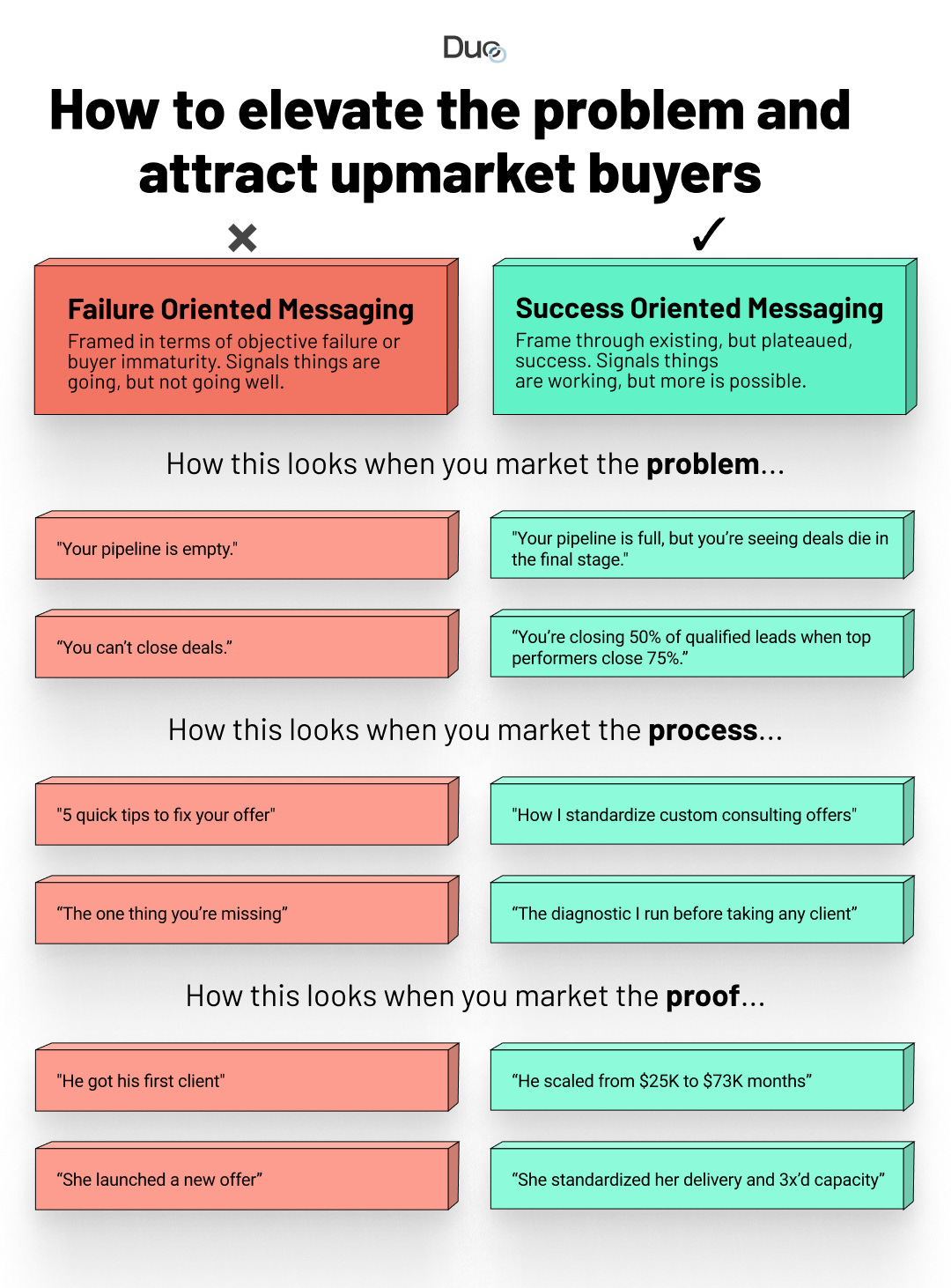
1. Elevate the Problem
Your problem framing is your most important business decision because it sets the floor and ceiling for every client conversation that follows.
Frame problems through failure indicators? You attract people in crisis mode.
“No one knows who you are.”
“Your pipeline is empty.”
“You can’t close deals.”
Frame problems through success indicators? You attract people in building mode.
“You’re landing on podcasts, but not booking calls.”
“Your pipeline is full, but deals die in the final stage.”
“You’re closing 50% of qualified leads when top performers in your space close 75%.”
This is where you choose your buyer tier. Failure framing pulls in people who need a lifeline. Success framing pulls in people who want a ladder to the next level.
2. Elevate the Process
Too many solos share process in a way that attracts students, not clients.
They teach people how to do it themselves instead of demonstrating why working together makes sense. That’s because people in failure mode want a quick fix. They’re looking for the hack, the shortcut, the magic bullet.
Failure-indicator process content:
“5 quick tips to fix your messaging”
“The one thing you’re missing”
“Do this tomorrow”
But when you share your process publicly, you filter for buyers who appreciate methodology.
People in success mode want a system. They’ve already proven they can execute. They know success isn’t random. They’re looking for a repeatable process that compounds.
Success-indicator process content:
“How I standardize custom consulting offers” (shows sophistication)
“The diagnostic I run before taking any client” (demonstrates rigor)
“Why we start with clarity before we touch content” (reveals methodology)
When you elevate the process, successful buyers think: “This person has thought this through. They’re not winging it.” Failure-mode buyers think: “This is too complex. I just need to know what to post.”
The process you share determines who self-selects into your world.
3. Elevate the Proof
This is where most solos accidentally cap themselves.
Sharing results builds credibility, but it also shows future buyers what’s possible and who you work with. If all your proof is from $5K projects, you’ll attract $5K clients. If all your proof is from $50K engagements, you’ll attract $50K clients.
It’s not about bragging—it’s about signaling.
Failure-tier proof:
“Helped Sarah get her first client”
“John finally launched his newsletter”
“Finalized Emma’s positioning”
Success-tier proof:
“Helped Brian scale from $25K to $73K months”
“Worked with Sarah to standardize her delivery so she could 3x capacity”
“John’s offers now convert at 40% instead of 15%”
Notice the difference? Failure-tier proof celebrates starting. Success-tier proof celebrates scaling. It’s the same transformation arc but a different entry point and buyer.
Every piece of content you create broadcasts a signal about who you serve and at what level they’re operating.
The proof from your current clients becomes the proof of concept for the next ones.
Frame through failure indicators, and you build an audience of people who can’t afford you. Frame through success indicators, and you build a pipeline of people ready to invest. But how do you know if your current framing is holding you back? And how do you actually elevate the problem in your business?
First, you need to diagnose where you are.
You then need a process to elevate the problem (if that makes sense for your business).
How To Recognize and Elevate Your Problem Framing
Elevating your problem framing isn’t changing what you do or how you do it. Your business model and offer stay the same. It’s about changing how you talk about what you do.
The main question to consider: Are the people showing up able to pay what you want to charge? If not, your problem framing is off. If yes, keep doing what you’re doing—and look for ways to refine even further.
Here are the steps:
Step 1: Audit Your Current Problem Framing
Pull up your website, your LinkedIn profile, your last 10 posts, and your sales page. Look at every place you describe the problem you solve and ask:
Am I using failure-indicator language like “no leads,” “no pipeline,” “struggling to close”?
Would someone reading this assume they’re in crisis mode?
Is my proof celebrating “starting” or “scaling”?
Write down every failure indicator you find. Be honest. Most of us do this without realizing it because it’s everywhere.
Step 2: Identify the Elevated Problem
Take each failure indicator you use and consider: What does this look like one level up?
Use this formula:
[Existing success] but [specific constraint]. This means [what’s at stake].
Here are a few examples:
“Your content strategy is failing” becomes: “You’re publishing consistently, but your content isn’t converting to calls. This means you’re working hard without revenue to show for it.”
“You have no systems” becomes: “You’re delivering great results for clients, but every project feels custom-built. This means you can’t scale past your current capacity.”
“Your offers are unclear” becomes: “You’re landing discovery calls, but prospects can’t see the path from A to B. This means deals stall and you’re leaving money on the table.”
“You can’t scale” becomes: “You’re at $30K/month but hit your capacity ceiling. This means every new client requires sacrificing something else.”
“Your positioning is broken” becomes: “You’re getting inbound, but from the wrong buyers. This means you’re spending time on calls that go nowhere.”
The key is specificity. You’re not saying everything is broken. You’re saying something specific is hitting a ceiling at a specific place.
Step 3: Talk to Your Ideal Clients
This is non-negotiable.
You can’t elevate the problem if you don’t know how to communicate the elevated problem. And you can’t know that without talking to people who are already at that level.
Ask them:
What was working before you hired someone like me?
What made you realize you needed help?
What specifically were you trying to fix or improve?
What language did you use when searching for a solution?
Which problem resonates more, A or B? (Test your elevated problems from Step 2.)
The goal is to find the exact words they use to describe the problem. That becomes part of your elevated framing. For example, our Duo Consulting website header says, “Your business is crushing it. Now, let’s stop it from crushing you.” These are almost the exact words a client used to describe our business.
Voice of customer is everything.
Step 4: Test and Align Your MP3
Once your problem framing is elevated, make sure you’re getting the right signal.
Market the Elevated Problem: Use your new elevated framing consistently
Market the Elevated Process: Share sophisticated methodology, not quick fixes
Market the Elevated Proof: Highlight transformations that match your target buyer tier
Remember: Every piece of content broadcasts a signal. Make sure all three parts of MP3 are signaling the same buyer maturity level.
Step 5: Rewrite Your Core Messaging
Once you’re getting the right signal, the final step is to apply your elevated problem framing across:
Your website homepage: Lead with the elevated problem, not the failure indicator
Your LinkedIn headline/bio: Position yourself as solving the elevated problem
Your content hooks: Frame through success + constraint, not failure alone
Your sales conversations: Start with “You’re already doing X well, but...” instead of “You’re struggling with X”
Elevating the problem isn’t a one-time fix. It’s a skill. You’ll need reps. You’ll need pattern recognition. You’ll get it wrong sometimes, and that’s fine.
But remember: Elevating the problem only works if you actually want to serve the elevated buyer.
If you genuinely want to work with early-stage solopreneurs building toward their first $10K months, or pre-seed founders still figuring out product-market fit, or scrappy startups running on savings and sweat equity, don’t elevate.
But if you want to work with established solopreneurs doing $30K+ months, funded startups with budget to spend, or companies that’ve already proven the model and need help scaling it, your problem framing needs to match that reality
The choice is yours to make, on purpose.
Cheers,
Nick, Erica, & Katrina
P.S. – Ready to standardize your custom consulting services? Book a call with Nick and Erica.
P.P.S – Want to share your unique POV with mini-books like this one? Book a call with Katrina.
Have questions? Ask us in a comment below.
I'm glad I found this post! As a copywriter, I'm used to using pain points. But I love how detailed you were and how you reframed it entirely into failure and success indicators. It just goes to show that when you really get specific on your messaging, you attract the right people. Thank you for expanding my perspective on that! Great read.
Great piece, thank you! I came across this article from an email distro and the fact that you were able to capture my attention to read it from start to finish deserves 👏🏻👏🏻👏🏻
And obvio, LinkedIn connect requests 😊
- Tara Eve Ezer